How To Become A Quantity Surveyor UK: Complete Guide

Welcome to our complete guide on how to become a quantity surveyor UK, where you will learn everything you need to know about entering one of the most rewarding careers in the construction and property sectors. Quantity surveyors play a vital role in managing project costs, controlling budgets, reducing financial risks, and helping construction projects run efficiently from start to finish. Whether you are a student exploring future career options, a professional considering a career change, or someone interested in the UK construction industry, this guide will walk you through the qualifications, skills, training routes, professional accreditation requirements, salary expectations, and career progression opportunities available. By the end, you will have a clear understanding of the steps needed to start and grow a successful career as a quantity surveyor in the UK.
To become a quantity surveyor in the UK, you typically need a relevant degree or apprenticeship, practical construction industry experience, and strong financial and analytical skills. Many professionals also work toward RICS accreditation to become chartered, improving their career prospects, earning potential, and professional credibility.
What Is A Quantity Surveyor?
A quantity surveyor is a construction and cost-management professional responsible for ensuring building and infrastructure projects are completed within budget while maintaining quality and compliance standards. Their role combines financial expertise, commercial awareness, and construction knowledge to help clients make informed decisions throughout a project’s lifecycle. From the early planning stages through to project completion, quantity surveyors play a critical role in controlling costs, managing contracts, and reducing financial risks. As construction projects become more complex, the demand for skilled quantity surveyors continues to grow across the UK, making it an attractive and respected career path.
The Role of a Quantity Surveyor
The primary role of a quantity surveyor is to manage the financial and contractual aspects of construction projects. They help ensure that resources are used efficiently, budgets remain under control, and projects achieve the best possible value without compromising quality or safety.
Managing Construction Costs
Construction projects involve significant financial investment, and cost control is one of the most important responsibilities of a quantity surveyor. They assess project requirements, estimate expenses, and monitor spending throughout each phase of the build.
Key areas of cost management include:
- Cost Estimation: Calculating expected project costs based on labour, materials, equipment, and site requirements.
- Budget Monitoring: Tracking actual spending against planned budgets to identify potential issues early.
- Cost Reporting: Providing regular financial updates to clients, project managers, and stakeholders.
- Value Engineering: Identifying cost-effective alternatives that maintain quality and performance.
By closely managing costs, quantity surveyors help prevent budget overruns and improve the overall financial success of a project.
Budget Planning and Financial Control
Before construction begins, quantity surveyors develop detailed budget plans that guide decision-making throughout the project. These budgets help clients understand expected costs and prepare financially for each stage of development.
Financial control responsibilities often include:
- Budget Development: Creating comprehensive financial plans based on project scope and objectives.
- Cash Flow Forecasting: Predicting when funds will be required during construction.
- Financial Analysis: Reviewing expenditures and assessing financial performance.
- Cost Recovery: Ensuring contractors and suppliers are paid accurately and according to agreed terms.
Strong financial control allows projects to remain commercially viable while reducing the likelihood of unexpected expenses.
Contract Administration and Procurement
Contracts form the foundation of every construction project, outlining responsibilities, timelines, and payment arrangements between parties. Quantity surveyors assist with preparing, reviewing, and administering these agreements to protect the interests of their clients.
Their procurement and contract-related duties may include:
- Tender Management: Preparing tender documents and evaluating contractor submissions.
- Contract Selection: Advising on the most suitable contract type for the project.
- Supplier Evaluation: Assessing suppliers and subcontractors based on quality, pricing, and reliability.
- Contract Compliance: Ensuring all parties meet their contractual obligations.
Effective contract administration helps minimise disputes and supports smoother project delivery.
Risk Management and Project Forecasting
Construction projects often face financial, operational, and scheduling risks. Quantity surveyors work proactively to identify potential challenges before they become costly problems.
Common risk-management activities include:
- Risk Identification: Assessing potential financial and contractual risks.
- Contingency Planning: Developing strategies to manage unexpected events.
- Forecasting: Predicting future costs and resource requirements.
- Change Management: Evaluating the financial impact of design changes or project variations.
By identifying risks early, quantity surveyors help clients make informed decisions and maintain greater control over project outcomes.
Key Responsibilities in Day-to-Day Work
The daily responsibilities of a quantity surveyor can vary depending on the project type, employer, and stage of construction. However, most professionals perform a combination of financial, contractual, and project-management tasks to ensure projects remain on track.
Preparing Cost Estimates
One of the most fundamental tasks is preparing accurate cost estimates. Quantity surveyors analyse plans, specifications, and project requirements to determine likely expenses before work begins.
These estimates help clients:
- Understand Costs: Gain a realistic picture of the project’s financial requirements.
- Compare Options: Evaluate different materials, designs, and construction methods.
- Plan Effectively: Allocate budgets with greater confidence.
Accurate estimating is essential for successful project planning and financial decision-making.
Monitoring Project Budgets
Once construction begins, quantity surveyors continually monitor spending to ensure budgets remain under control. This involves reviewing invoices, assessing completed work, and comparing actual costs against projections.
Regular budget monitoring helps:
- Identify Cost Variations: Detect unexpected expenses early.
- Improve Financial Oversight: Maintain visibility of project spending.
- Support Decision-Making: Provide stakeholders with reliable financial information.
Negotiating With Contractors and Suppliers
Strong negotiation skills are an important part of the profession. Quantity surveyors regularly negotiate prices, payment terms, and contract conditions to achieve the best value for their clients.
Effective negotiations can help:
- Reduce Project Costs: Secure competitive pricing.
- Improve Contract Terms: Protect client interests.
- Build Strong Relationships: Encourage productive collaboration with suppliers and contractors.
Managing Construction Contracts
Throughout the project lifecycle, quantity surveyors oversee contractual arrangements to ensure all parties meet their responsibilities.
This often includes:
- Reviewing Contract Terms: Confirming compliance with agreed conditions.
- Managing Variations: Assessing changes to project scope and costs.
- Resolving Disputes: Addressing contractual disagreements when they arise.
- Certifying Payments: Verifying completed work before payments are issued.
Contract management helps maintain fairness, transparency, and accountability across the project team.
Reporting on Project Finances
Regular reporting is a critical part of keeping stakeholders informed about project performance. Quantity surveyors prepare financial reports that outline spending, forecasts, risks, and overall budget status.
These reports typically provide:
- Cost Summaries: Current financial performance.
- Budget Updates: Comparison of planned and actual costs.
- Risk Assessments: Potential financial concerns.
- Forecast Information: Expected future spending requirements.
Clear financial reporting supports better decision-making and improves project oversight.
Industries Where Quantity Surveyors Work
Quantity surveyors are employed across a wide range of construction and infrastructure sectors. Their expertise in cost management and commercial planning is valuable wherever projects involve significant financial investment.
Residential Construction
In residential construction, quantity surveyors work on projects ranging from individual homes to large-scale housing developments. They help manage costs, evaluate contractor bids, and ensure budgets remain realistic throughout the build.
Commercial Developments
Commercial projects often involve offices, retail centres, hotels, and industrial facilities. These developments typically require careful financial planning due to their size, complexity, and investment value.
Quantity surveyors help balance construction costs while supporting the commercial objectives of developers and investors.
Infrastructure Projects
Infrastructure developments include roads, rail networks, airports, utilities, and public transportation systems. These projects often involve substantial budgets and long-term planning, making professional cost management essential.
Quantity surveyors contribute by forecasting costs, managing procurement processes, and maintaining financial control throughout project delivery.
Civil Engineering
Civil engineering projects focus on the design and construction of structures such as bridges, tunnels, water systems, and environmental infrastructure. Quantity surveyors play an important role in controlling costs while supporting project efficiency and compliance requirements.
Public Sector Projects
Government-funded developments often require strict budget oversight and accountability. Quantity surveyors support schools, hospitals, public housing developments, and community infrastructure projects by ensuring funds are used effectively and transparently.
Their involvement helps public organisations achieve value for money while delivering essential services and facilities to local communities.
A career in quantity surveying offers a unique combination of financial expertise, construction knowledge, and problem-solving responsibility. Whether working on residential developments, major infrastructure projects, or public-sector initiatives, quantity surveyors help ensure projects remain financially successful while supporting efficient and sustainable construction outcomes.

Why Choose A Career In Quantity Surveying?
Quantity surveying is a rewarding profession that combines financial expertise, problem-solving abilities, and involvement in real-world construction projects. As the UK construction industry continues to expand, quantity surveyors play an essential role in helping projects stay financially viable while balancing quality, timelines, and costs. The profession offers a strong mix of job security, earning potential, career advancement, and professional recognition, making it an attractive option for people who enjoy analytical work and want to contribute to the built environment.
High Demand Across the UK Construction Sector
The demand for quantity surveyors remains strong across the UK due to ongoing construction activity and a growing need for skilled professionals who can manage project finances effectively. From residential housing developments to large-scale infrastructure projects, organisations rely on quantity surveyors to help control costs and improve financial outcomes.
One of the biggest factors driving demand is the industry’s skills shortage. Many experienced professionals are approaching retirement, while construction activity continues to increase. This creates opportunities for new entrants who have the right qualifications and practical skills.
Growing infrastructure and development projects are also contributing to the need for qualified quantity surveyors. Major public and private investments require professionals who can accurately forecast costs, manage contracts, and reduce financial risks throughout the project lifecycle.
Some of the key reasons demand remains high include:
- Skills Shortages: Many construction companies face challenges recruiting qualified quantity surveyors, creating strong employment opportunities for graduates and experienced professionals alike.
- Infrastructure Investment: Government-funded transport, energy, and public sector projects require experienced cost-management professionals to oversee budgets and procurement.
- Housing Development: The continued need for new homes across the UK supports long-term demand for quantity surveying services within residential construction.
- Commercial Construction: Office developments, retail spaces, industrial facilities, and mixed-use projects all rely on quantity surveyors to maintain financial control.
Because quantity surveying skills are transferable across multiple sectors, professionals often have flexibility when choosing the types of projects and industries they want to work in throughout their careers.
Strong Salary Potential
One of the most attractive aspects of a quantity surveying career is the potential to earn a competitive salary while benefiting from clear progression opportunities. Earnings typically increase as professionals gain experience, develop specialist knowledge, and achieve professional accreditation.
Entry-level quantity surveyors often begin their careers in graduate or assistant positions where they learn practical skills while working under the guidance of senior professionals. As their experience grows, they become responsible for managing larger budgets, more complex contracts, and higher-value projects.
Salary progression generally follows a structured pathway:
- Entry-Level Earnings: Graduate and assistant quantity surveyors can expect competitive starting salaries while gaining valuable industry experience.
- Mid-Level Earnings: Experienced quantity surveyors often see substantial salary growth as they take on greater project responsibilities and client-facing duties.
- Senior-Level Earnings: Senior quantity surveyors and specialist professionals typically earn higher salaries due to their expertise in managing large-scale projects and commercial risks.
- Chartered Professionals: Achieving chartered status can further improve earning potential and increase access to leadership opportunities.
In addition to base salaries, many employers offer benefits such as performance bonuses, professional development support, pension contributions, and flexible working arrangements. These factors contribute to the overall attractiveness of the profession.
Career Progression Opportunities
Quantity surveying offers a well-defined career pathway with numerous opportunities for advancement. Professionals can choose to specialise in specific sectors, move into management positions, or pursue strategic leadership roles within construction and consultancy firms.
As experience increases, quantity surveyors often take on more responsibility for project planning, financial oversight, and client management. This progression allows them to develop both technical expertise and leadership capabilities.
Common career advancement opportunities include:
- Senior Quantity Surveyor: Responsible for overseeing larger projects, mentoring junior staff, and managing complex commercial activities.
- Commercial Manager: Focuses on broader financial strategy, contract management, procurement processes, and overall project profitability.
- Cost Consultant: Provides independent cost advice and financial planning services to clients across various construction sectors.
- Director-Level Positions: Senior leaders help shape company strategy, manage major client relationships, and oversee business growth initiatives.
Many professionals also choose to specialise in sectors such as infrastructure, healthcare, residential development, commercial construction, or renewable energy projects. Specialisation can enhance expertise and create additional career opportunities within high-growth industries.
Opportunities for Professional Recognition
Professional recognition plays an important role in building credibility and advancing a quantity surveying career. Employers, clients, and industry stakeholders often place significant value on recognised professional qualifications and memberships.
One of the most respected achievements within the profession is becoming a Chartered Quantity Surveyor. Chartered status demonstrates that an individual has met rigorous professional standards and possesses the knowledge, skills, and experience required to perform at a high level.
The Royal Institution of Chartered Surveyors (RICS) is widely recognized as the leading professional body for quantity surveyors and other property professionals. Membership can provide numerous advantages throughout a person’s career.
Benefits of professional recognition include:
- Enhanced Credibility: Chartered status demonstrates professionalism, competence, and commitment to industry standards.
- Improved Career Prospects: Many employers actively seek chartered professionals when hiring for senior and specialist positions.
- Higher Earning Potential: Professional accreditation can strengthen salary negotiations and support long-term career growth.
- Industry Recognition: RICS membership is respected both within the UK and internationally, creating opportunities across global markets.
- Professional Development: Members gain access to industry resources, training opportunities, networking events, and continuing professional development programmes.
Achieving professional recognition not only validates expertise but also helps quantity surveyors build trust with clients, employers, and colleagues throughout their careers.
A career in quantity surveying offers a unique combination of financial rewards, long-term job security, professional development, and meaningful involvement in shaping the built environment. For individuals who enjoy analytical thinking, problem-solving, and working on projects that have a lasting impact, quantity surveying can provide a fulfilling and highly respected career path.

What Qualifications Do You Need To Become A Quantity Surveyor In The UK?
If you are interested in becoming a quantity surveyor in the UK, there are several education and training pathways available. The route you choose will often depend on your current qualifications, career goals, and whether you prefer full-time study or a work-based learning approach. Employers in the construction industry generally look for candidates with a strong understanding of construction costs, project management, contracts, and commercial practices. Fortunately, there are multiple ways to gain the knowledge and experience needed to enter this profession and build a successful long-term career.
University Degree Route
For many aspiring professionals, completing a university degree is the most direct path into quantity surveying. Degree programs provide a strong foundation in construction economics, cost planning, procurement, contract administration, and project management. These skills are essential for managing budgets and ensuring construction projects remain financially successful.
Quantity Surveying Degrees
A Quantity Surveying degree is specifically designed to prepare students for the profession. These courses focus on both the technical and commercial aspects of construction projects while providing a detailed understanding of cost control and financial management.
Students typically learn about:
- Construction Economics: Understanding how financial decisions affect construction projects.
- Cost Estimation: Learning how to prepare accurate project budgets and forecasts.
- Contract Management: Understanding contractual obligations and legal requirements.
- Measurement Techniques: Calculating quantities of materials and labour costs for construction work.
Many universities also include industry placements that allow students to gain practical experience before graduating.
Construction Management Degrees
A Construction Management degree is another popular route into quantity surveying. While these courses cover a broader range of construction topics, they often include modules that focus on project costs, budgeting, procurement, and commercial management.
This pathway may be suitable for individuals who want flexibility within the construction industry and may later pursue roles in project management, site management, or commercial management alongside quantity surveying opportunities.
Commercial Management in Construction
Commercial Management in Construction degrees focus heavily on the financial and business aspects of construction projects. Students develop skills in budgeting, procurement, risk assessment, and commercial strategy.
This qualification is particularly valuable for those who are interested in the commercial side of large-scale construction developments and want to understand how financial decisions impact project outcomes from planning through completion.
RICS-Accredited Courses
Choosing a RICS-accredited course is highly recommended for anyone planning a long-term career in quantity surveying. The Royal Institution of Chartered Surveyors (RICS) is one of the most respected professional bodies within the industry.
RICS-accredited courses are designed to meet industry standards and can make it easier to progress toward chartered status later in your career. Many employers actively seek graduates from accredited programs because they know these qualifications align with recognised professional requirements.
Degree Apprenticeships
Degree apprenticeships have become an increasingly popular route for people who want to gain practical experience while earning a qualification. This pathway combines academic learning with real-world work experience, allowing apprentices to develop valuable industry knowledge from the start of their careers.
How Quantity Surveying Apprenticeships Work
A quantity surveying degree apprenticeship typically involves working for an employer while studying part-time through a university or training provider. Apprentices divide their time between workplace responsibilities and academic coursework.
During the apprenticeship, individuals may assist with:
- Cost Planning: Supporting budget preparation and project forecasting.
- Project Monitoring: Tracking project costs and financial performance.
- Procurement Activities: Assisting with supplier and contractor selection.
- Contract Administration: Helping manage project documentation and agreements.
This combination of theory and practical application helps apprentices develop job-ready skills while building industry experience.
Combining Work Experience With Study
One of the biggest advantages of a degree apprenticeship is the opportunity to apply classroom learning directly to live construction projects. Instead of waiting until graduation to gain experience, apprentices begin building professional skills from the first day of employment.
This hands-on approach helps develop confidence in areas such as cost management, communication, problem-solving, and client interaction. Employers often value candidates who have already demonstrated their abilities in real project environments.
Benefits of Earning While Learning
Many people choose apprenticeships because they offer both educational and financial advantages.
Key benefits include:
- Reduced Student Debt: Tuition costs are often covered by employers and government funding.
- Industry Experience: Apprentices gain valuable practical knowledge throughout their training.
- Professional Networking: Working alongside experienced professionals helps build industry connections.
- Career Opportunities: Many apprentices secure permanent positions after completing their programmes.
This route can provide a strong foundation for long-term career development while avoiding some of the financial pressures associated with full-time university study.
Conversion and Postgraduate Routes
Not everyone decides to become a quantity surveyor at the beginning of their academic journey. Many successful professionals enter the field after studying a different subject or working in another industry. Conversion and postgraduate routes provide flexible opportunities for career changers and graduates who want to move into quantity surveying.
For Career Changers
Career changers often bring valuable transferable skills that can support a successful transition into quantity surveying. Experience in finance, engineering, architecture, construction, project management, or business can provide a useful foundation for learning commercial construction practices.
Many employers appreciate candidates who offer diverse professional backgrounds, particularly when those experiences contribute to stronger communication, leadership, or analytical skills.
Relevant Postgraduate Qualifications
Postgraduate courses are designed to help graduates develop specialist knowledge in quantity surveying and commercial management. These programmes often focus on core industry skills while building on existing academic or professional experience.
Common postgraduate options include:
- MSc Quantity Surveying: A specialist qualification focused on cost management and construction economics.
- MSc Construction Project Management: Combining project delivery with commercial management principles.
- MSc Commercial Management: Developing advanced financial and procurement skills within construction environments.
Many postgraduate programmes are also accredited by RICS, helping graduates progress toward professional recognition.
Fast-Track Options for Graduates
Graduates with relevant degrees may be eligible for accelerated training routes that allow them to enter the profession more quickly. Some employers offer graduate development programmes that combine structured learning with practical project experience.
These fast-track pathways are particularly attractive for individuals who already possess strong analytical, financial, engineering, or construction-related knowledge. By building on existing qualifications, graduates can often shorten the time required to establish themselves within the quantity surveying profession.
Whether you choose a university degree, apprenticeship, or postgraduate conversion route, the most important factor is selecting a pathway that aligns with your goals and learning style. With the right qualifications, practical experience, and commitment to professional development, you can build a rewarding career as a quantity surveyor in the UK and take advantage of the growing opportunities within the construction industry.
Building the right educational foundation is the first step toward becoming a successful quantity surveyor. By choosing a recognized qualification and gaining practical industry experience, you can develop the skills, knowledge, and professional credibility needed to thrive in this highly respected and in-demand profession.

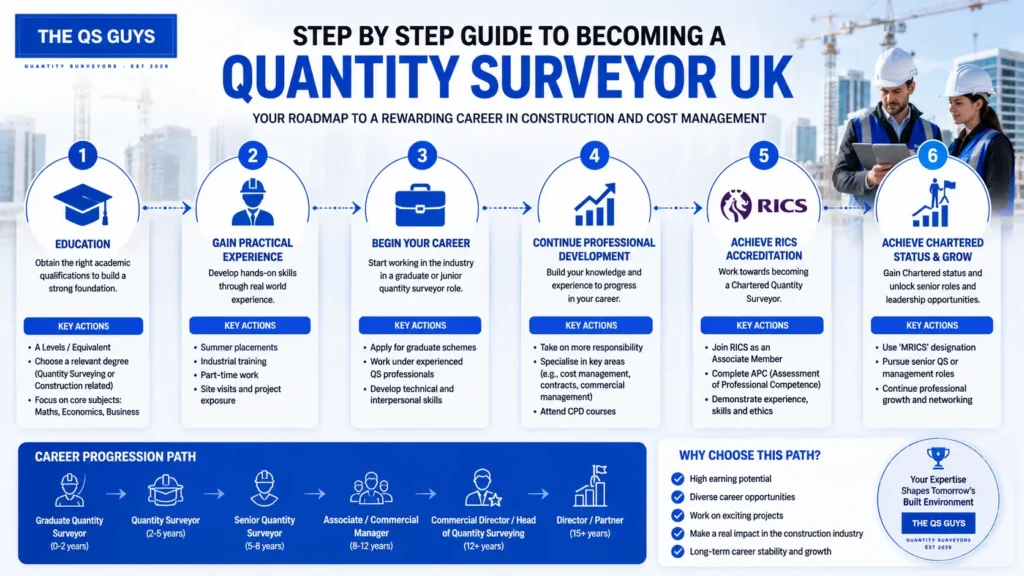
Step-by-Step Guide To Becoming A Quantity Surveyor UK
A successful career in quantity surveying combines formal education, practical experience, technical knowledge, and professional development. While individual journeys may vary, most professionals follow a similar progression that helps them develop both the commercial and construction-related expertise required to manage project costs effectively.
Step 1 – Complete Relevant Education
Education provides the foundation for understanding construction processes, cost management, contracts, and project delivery. Building strong academic knowledge early can make it easier to progress into entry-level roles and professional training programmes.
GCSE and A-Level Recommendations
Students interested in quantity surveying should focus on subjects that develop analytical, mathematical, and communication skills. Strong GCSE and A-Level results can improve access to university courses, apprenticeships, and graduate opportunities.
Some of the most beneficial subjects include:
- Mathematics: Helps develop budgeting, measurement, forecasting, and cost-analysis skills.
- English Language: Supports report writing, communication, and contract interpretation.
- Business Studies: Introduces commercial principles and financial management concepts.
- Economics: Provides insight into market conditions, investment decisions, and project costs.
- Physics: Helps build an understanding of construction-related calculations and technical concepts.
While universities and employers may have different entry requirements, strong performance in mathematics is particularly valuable for future quantity surveyors.
Relevant Subjects
Many aspiring professionals choose degree programmes that are directly related to the construction industry. Employers often favour candidates with qualifications that provide both technical and commercial knowledge.
Popular degree options include:
- Quantity Surveying: The most direct route into the profession.
- Construction Management: Focuses on project planning, delivery, and management.
- Commercial Management and Quantity Surveying: Combines financial and construction-related disciplines.
- Building Surveying: Offers broader property and construction knowledge.
- Civil Engineering: Provides technical understanding of infrastructure and construction projects.
Choosing a Royal Institution of Chartered Surveyors (RICS) accredited programme can provide additional advantages when pursuing professional accreditation later in your career.
Step 2 – Gain Practical Industry Experience
While education provides theoretical knowledge, practical experience is what transforms that knowledge into professional competence. Employers consistently look for candidates who understand how construction projects operate in real-world environments.
Internships
Internships provide valuable exposure to the daily responsibilities of quantity surveyors. Students and graduates can observe cost planning, project budgeting, procurement activities, and contract administration while working alongside experienced professionals.
Internships often help individuals:
- Understand Industry Processes: Gain firsthand exposure to project lifecycles.
- Build Professional Networks: Establish relationships with employers and industry professionals.
- Develop Workplace Skills: Learn how commercial decisions affect construction projects.
- Improve Employability: Demonstrate practical experience when applying for future roles.
Work Placements
Many university programmes include work-placement opportunities that allow students to spend extended periods working within construction companies, consultancy firms, or property organisations.
Work placements help bridge the gap between academic learning and industry expectations by providing hands-on experience in professional environments.
Graduate Schemes
Graduate schemes are structured training programmes offered by construction firms, consultancies, and infrastructure organisations. These programmes typically combine practical experience with mentoring and professional development.
Benefits of graduate schemes include:
- Structured Learning: Follow a planned development pathway.
- Professional Support: Receive guidance from experienced quantity surveyors.
- Industry Exposure: Work across multiple projects and departments.
- Accreditation Preparation: Gain experience aligned with professional competency requirements.
Assistant Quantity Surveyor Roles
Many professionals begin their careers as Assistant Quantity Surveyors. This role provides practical exposure to cost planning, tender preparation, contract administration, and project monitoring.
Working as an assistant allows individuals to build confidence while gradually taking on greater responsibility under supervision from senior professionals.
Step 3 – Develop Core Quantity Surveying Skills
Technical qualifications alone are not enough to succeed in quantity surveying. Employers expect professionals to possess a combination of commercial, financial, analytical, and interpersonal skills that contribute to project success.
Cost Estimation
Cost estimation sits at the heart of quantity surveying. Professionals must accurately forecast project expenses while considering labour, materials, equipment, risks, and market conditions.
Strong cost-estimation skills help businesses:
- Control Project Budgets: Prevent unnecessary overspending.
- Improve Planning Accuracy: Support informed decision-making.
- Reduce Financial Risks: Identify potential cost challenges early.
- Increase Profitability: Ensure projects remain commercially viable.
Commercial Awareness
Quantity surveyors play an important role in protecting the financial interests of clients and organisations. This requires a strong understanding of commercial principles and industry trends.
Commercial awareness includes understanding:
- Construction Market Conditions: Monitor pricing and supply chain changes.
- Contractual Obligations: Recognise financial responsibilities and risks.
- Business Objectives: Align project decisions with commercial goals.
- Procurement Strategies: Select cost-effective purchasing approaches.
Financial Management
Financial management skills allow quantity surveyors to monitor project performance and maintain budget control throughout construction.
Key responsibilities often include:
- Cash Flow Forecasting: Predict future project expenditure.
- Budget Monitoring: Track actual spending against forecasts.
- Financial Reporting: Provide stakeholders with accurate updates.
- Cost Control Measures: Identify opportunities to improve efficiency.
Communication and Negotiation
Quantity surveyors regularly communicate with clients, contractors, consultants, suppliers, and project teams. Strong communication skills help ensure everyone understands project expectations and financial requirements.
Negotiation skills are equally important when discussing contracts, pricing, variations, and procurement agreements. Effective negotiators can often secure favourable outcomes while maintaining positive professional relationships.
Step 4 – Work Toward Professional Accreditation
Professional accreditation demonstrates competence, commitment, and credibility within the industry. For many quantity surveyors, becoming chartered represents a significant career milestone.
RICS Pathway
The Royal Institution of Chartered Surveyors is one of the most respected professional bodies within the property and construction sectors. RICS membership is recognised both within the UK and internationally.
Following the RICS pathway helps professionals demonstrate industry-recognised standards of knowledge, ethics, and competence.
APC (Assessment of Professional Competence)
The Assessment of Professional Competence, commonly known as APC, is the process through which candidates demonstrate their ability to perform effectively as professional surveyors.
The APC typically involves:
- Structured Training: Building experience across key competency areas.
- Professional Development: Recording learning and practical achievements.
- Case Study Preparation: Demonstrating project knowledge and decision-making ability.
- Final Assessment: Completing interviews and competency evaluations.
The APC is designed to ensure candidates can apply their knowledge confidently in real-world situations.
Chartered Status
Successfully completing the APC allows professionals to achieve Chartered Quantity Surveyor status and use the MRICS designation.
Benefits of chartered status include:
- Enhanced Professional Credibility: Demonstrates recognised expertise.
- Greater Career Opportunities: Opens doors to senior roles.
- Improved Earning Potential: Many employers value chartered professionals.
- International Recognition: Supports opportunities in global markets.
Step 5 – Progress Within the Industry
Quantity surveying offers significant opportunities for long-term career growth. As professionals gain experience, they can move into more specialised, senior, or strategic positions.
Career Advancement Opportunities
Career progression often follows a structured path, with increasing responsibility at each stage.
Typical progression may include:
- Assistant Quantity Surveyor
- Quantity Surveyor
- Senior Quantity Surveyor
- Commercial Manager
- Commercial Director
- Construction Director
Advancement often depends on technical expertise, leadership abilities, professional qualifications, and project experience.
Specialist Sectors and Leadership Roles
Many experienced quantity surveyors choose to specialise in particular sectors that align with their interests and expertise.
Common specialist areas include:
- Infrastructure Projects: Roads, railways, and utilities.
- Residential Development: Housing and apartment projects.
- Commercial Construction: Offices, retail spaces, and mixed-use developments.
- Healthcare Facilities: Hospitals and medical centres.
- Public Sector Projects: Government-funded developments.
Leadership opportunities may involve overseeing commercial teams, managing large-scale projects, developing business strategies, or providing consultancy services at a senior level.
Becoming a quantity surveyor in the UK requires dedication, continuous learning, and practical industry experience, but the rewards can be substantial. By combining the right qualifications with hands-on experience, professional accreditation, and strong commercial skills, aspiring quantity surveyors can build a respected career that offers stability, progression, and opportunities across a wide range of construction sectors.
Essential Skills Every Quantity Surveyor Needs
A successful quantity surveyor needs a combination of technical knowledge, financial expertise, strong communication abilities, and problem-solving skills. While qualifications and industry experience provide an important foundation, employers also look for professionals who can manage costs, communicate effectively with stakeholders, and make informed decisions throughout the life cycle of a construction project. Developing these essential skills helps quantity surveyors deliver value, reduce risks, and contribute to the successful completion of projects across the UK construction industry.
Technical Skills
Technical skills form the backbone of quantity surveying. These abilities allow professionals to accurately estimate costs, understand construction processes, and manage contracts effectively. A strong technical foundation helps ensure projects remain financially viable while meeting quality and compliance requirements.
- Cost Planning: Cost planning involves estimating project expenses from the earliest stages of development. Quantity surveyors assess materials, labour, equipment, and other project-related costs to create realistic budgets that support informed decision-making.
- Quantity Take-Offs: Quantity take-offs involve measuring and calculating the materials and resources required for a project. Accurate quantity take-offs help prevent budget overruns, reduce waste, and provide reliable information for tendering and procurement.
- Construction Technology: Understanding construction technology allows quantity surveyors to evaluate building methods, materials, and systems. This knowledge helps them identify cost-effective solutions while ensuring projects meet technical specifications and industry standards.
- Contract Management: Construction projects rely on legally binding agreements between multiple parties. Quantity surveyors must understand contract terms, obligations, and risk allocation to ensure projects are delivered according to agreed requirements and timelines.
Financial And Analytical Skills
Financial management is at the heart of quantity surveying. Professionals in this field are responsible for monitoring costs, identifying financial risks, and helping clients maximise the value of their investments. Strong analytical skills enable quantity surveyors to interpret complex information and make data-driven recommendations.
- Budgeting: Budgeting involves creating and maintaining detailed financial plans for construction projects. Quantity surveyors monitor spending throughout the project and ensure resources are allocated efficiently.
- Forecasting: Forecasting helps project teams anticipate future costs and financial challenges. By analysing project progress and market conditions, quantity surveyors can identify potential budget issues before they become significant problems.
- Cost Control: Effective cost control requires continuous monitoring of project expenses. Quantity surveyors compare actual costs against planned budgets and recommend corrective actions when necessary to keep projects on track financially.
- Data Analysis: Modern quantity surveying increasingly relies on data analysis to support decision-making. Professionals use project data, financial reports, and market information to identify trends, assess risks, and improve project outcomes.
Communication And Negotiation Skills
Quantity surveyors regularly work with clients, contractors, consultants, suppliers, and project teams. Strong communication and negotiation skills help maintain positive relationships while ensuring project objectives are achieved.
- Client Interaction: Quantity surveyors must explain technical and financial information in a way that clients can easily understand. Clear communication helps build trust and supports informed decision-making throughout the project.
- Contractor Negotiations: Negotiating with contractors is an important part of controlling project costs and resolving disputes. Effective negotiators can secure favourable outcomes while maintaining professional working relationships.
- Team Collaboration: Construction projects involve multiple stakeholders working toward shared goals. Quantity surveyors must collaborate effectively with architects, engineers, project managers, and contractors to ensure smooth project delivery.
Problem-Solving And Attention To Detail
Construction projects often encounter unexpected challenges, making problem-solving and attention to detail essential qualities for quantity surveyors. These skills help professionals identify issues early and develop practical solutions that protect project budgets and timelines.
- Managing Project Risks: Every construction project involves financial, contractual, and operational risks. Quantity surveyors assess potential risks, evaluate their impact, and implement strategies to minimise disruptions and unexpected costs.
- Identifying Cost-Saving Opportunities: One of the most valuable contributions a quantity surveyor can make is finding ways to improve efficiency without compromising quality. This may involve recommending alternative materials, improving procurement strategies, or identifying more cost-effective construction methods.
The most successful quantity surveyors combine technical expertise with strong commercial awareness and effective communication skills. By continuously developing these core abilities, aspiring professionals can build rewarding careers, support successful project delivery, and create long-term value for clients and construction teams alike.

How Long Does It Take To Become A Quantity Surveyor In The UK?
The time it takes to become a quantity surveyor in the UK depends on the pathway you choose, your educational background, and the level of professional qualification you aim to achieve. Some people enter the profession through a traditional university degree, while others prefer apprenticeships or transition from related careers within the construction industry. Although there is no single route that fits everyone, understanding the typical timelines can help you plan your career more effectively and set realistic expectations for professional growth.
Traditional University Route Timeline
The traditional university route remains one of the most common ways to become a quantity surveyor in the UK. This pathway typically begins with completing GCSEs and A-Levels or equivalent qualifications before enrolling in a relevant degree programme.
Most undergraduate Quantity Surveying degrees take three years to complete when studied full-time. Some universities offer four-year courses that include a work-placement year, allowing students to gain valuable industry experience before graduation. During their studies, students learn essential topics such as construction technology, cost planning, procurement, contract administration, and project management.
After graduating, many individuals secure positions as Graduate Quantity Surveyors or Assistant Quantity Surveyors. At this stage, they continue developing practical skills under the supervision of experienced professionals. Those seeking Chartered Surveyor status through the Royal Institution of Chartered Surveyors (RICS) typically spend an additional two to three years completing the Assessment of Professional Competence (APC).
A typical timeline may look like this:
- University Degree: Three to four years
- Graduate Employment and APC Preparation: Two to three years
- Chartered Status Achievement: Approximately five to seven years from the start of university
While this route requires a significant investment of time, it provides a strong academic foundation and is highly respected by employers throughout the UK construction sector.
Apprenticeship Route Timeline
An apprenticeship offers an alternative route that combines education with hands-on industry experience. This pathway has become increasingly popular among those who prefer practical learning and want to earn an income while working toward professional qualifications.
A Quantity Surveying Degree Apprenticeship generally takes between four and six years to complete. Apprentices divide their time between workplace responsibilities and structured academic study, often leading to a degree qualification upon completion.
One of the major advantages of this route is that apprentices gain real-world experience from the beginning of their careers. They learn how projects operate, work directly with clients and contractors, and develop commercial awareness while studying.
A typical apprenticeship timeline may include:
- Degree Apprenticeship Programme: Four to six years
- Professional Development: Ongoing throughout the apprenticeship
- Potential Chartered Status Preparation: Incorporated into the programme or completed shortly after qualification
Although the overall timeline can be similar to the university route, apprentices often graduate with several years of practical experience already on their CV, which can provide a competitive advantage when applying for future roles.
Career Change Route Timeline
Many successful quantity surveyors begin their careers in other professions before transitioning into the field. Individuals with backgrounds in construction, engineering, architecture, project management, or commercial management often possess transferable skills that support a smoother transition.
The timeline for career changers varies considerably depending on existing qualifications and experience. Some professionals choose to complete a postgraduate qualification in Quantity Surveying, which typically takes one to two years. Others may enter assistant-level roles and gain industry-specific knowledge through workplace training.
For those who already have a degree in a related discipline, conversion courses can accelerate the process significantly. Employers often value practical construction knowledge, meaning experienced professionals may progress more quickly than someone entering the industry for the first time.
A career-change pathway may involve:
- Postgraduate Conversion Course: One to two years
- Assistant Quantity Surveyor Experience: One to three years
- Professional Accreditation: Two to three years, depending on career goals
In many cases, career changers can establish themselves in the profession within three to five years, particularly if they already have relevant industry experience.
Factors That Influence Progression Speed
Although qualification routes provide general timelines, several factors can affect how quickly someone progresses within the profession. Individual circumstances, career choices, and workplace opportunities all play important roles.
- Educational Background: Candidates with relevant degrees or construction-related qualifications may advance more quickly than those starting from scratch.
- Industry Experience: Previous construction, engineering, or commercial experience can shorten the learning curve and improve employability.
- Professional Accreditation Goals: Pursuing Chartered Surveyor status through RICS requires additional training, documentation, and assessment.
- Employer Support: Companies that offer structured graduate programmes, mentoring, and APC support can help accelerate professional development.
- Personal Commitment: Continuous learning, professional networking, and proactive career development often contribute to faster progression.
- Economic Conditions: Construction market demand can influence hiring opportunities, project availability, and career advancement prospects.
While timelines vary from person to person, individuals who actively pursue professional development and gain practical experience often progress more rapidly than those who rely solely on academic qualifications.
Whether you choose the university route, an apprenticeship, or a career-change pathway, becoming a quantity surveyor is a long-term investment in a profession that offers strong career prospects, competitive salaries, and opportunities for continued advancement throughout the UK construction industry. With the right combination of education, experience, and professional commitment, you can build a rewarding career and steadily progress toward senior or chartered-level positions.

Quantity Surveyor Salary In The UK
One of the main reasons many people consider a career in quantity surveying is the strong earning potential combined with long-term career stability. Salaries can vary depending on experience, qualifications, location, and the type of projects you work on, but quantity surveying is widely regarded as one of the more financially rewarding professions within the UK construction industry. From graduate positions through to senior leadership roles, there are opportunities to increase earnings as you gain experience, develop specialist knowledge, and achieve professional accreditation.
Graduate Quantity Surveyor Salary
Graduate quantity surveyors are typically at the beginning of their careers and are focused on building practical knowledge while applying what they learned through their degree or apprenticeship. At this stage, employers often provide structured training, mentoring, and support to help new professionals develop their technical and commercial skills.
Graduate quantity surveyors in the UK can expect a competitive starting salary, with earnings varying depending on the employer, region, and project sector. Larger construction companies, consultancy firms, and infrastructure organisations often offer higher starting packages than smaller businesses.
Graduate-level roles often provide additional benefits alongside salary, including:
- Professional Development: Support for training courses, industry certifications, and career progression.
- Mentoring Opportunities: Guidance from experienced quantity surveyors and commercial managers.
- RICS Support: Assistance with completing the Assessment of Professional Competence process.
- Performance Bonuses: Additional financial incentives linked to individual or company performance.
For many graduates, the first few years are focused on gaining practical experience that will lead to higher-paying opportunities later in their careers.
Assistant Quantity Surveyor Salary
Assistant quantity surveyors have usually gained some hands-on industry experience and take on greater responsibility within project teams. They often work closely with senior quantity surveyors while managing specific commercial tasks independently.
An assistant quantity surveyor may be responsible for preparing cost reports, reviewing contracts, managing procurement activities, and assisting with budget control. As their skills and confidence grow, employers often reward this increased responsibility with higher salaries and additional benefits.
Several factors contribute to salary growth at this level:
- Project Responsibility: Managing larger sections of a project often leads to higher earnings.
- Technical Competence: Strong cost-planning and contract-management skills increase professional value.
- Industry Experience: Practical knowledge gained from completed projects improves employability.
- Career Progression: Demonstrating leadership potential can accelerate promotion opportunities.
This stage is often considered a critical stepping stone toward becoming a fully qualified quantity surveyor.
Chartered Quantity Surveyor Salary
Achieving chartered status is one of the most important career milestones for a quantity surveyor. Chartered quantity surveyors have demonstrated professional competence through recognised industry standards and are often viewed as trusted experts within their field.
Employers frequently place a high value on chartered professionals because they bring a proven level of expertise, professionalism, and commercial understanding. As a result, chartered quantity surveyors often earn significantly more than their non-chartered counterparts.
Benefits of becoming a chartered quantity surveyor include:
- Higher Earning Potential: Chartered professionals are often eligible for more senior and better-paid positions.
- Greater Career Opportunities: Many employers prefer or require chartered status for leadership roles.
- Industry Recognition: Professional accreditation strengthens credibility with clients and employers.
- Global Mobility: Chartered qualifications are respected in many international construction markets.
For professionals seeking long-term career growth, obtaining chartered status can provide a substantial return on investment.
Senior And Commercial Management Salaries
As quantity surveyors gain extensive experience, many progress into senior quantity surveyor, commercial manager, or director-level positions. These roles involve overseeing larger teams, managing complex projects, and making strategic commercial decisions that impact project profitability.
Senior professionals are expected to possess strong leadership skills, advanced commercial awareness, and a deep understanding of construction contracts, risk management, and financial planning. Because of these responsibilities, salaries at this level are often among the highest within the construction sector.
Senior and commercial management positions may involve:
- Team Leadership: Managing quantity surveyors, estimators, and commercial staff.
- Strategic Planning: Developing long-term financial strategies for projects and organisations.
- Client Management: Building and maintaining relationships with key stakeholders.
- Risk Oversight: Identifying and managing commercial risks across multiple projects.
Professionals who successfully move into commercial management often benefit from performance-based bonuses, profit-sharing schemes, and other executive-level incentives.
Factors That Affect Earnings
While career progression plays a significant role in salary growth, several other factors influence how much a quantity surveyor can earn throughout their career.
Experience
Experience remains one of the strongest drivers of salary growth. Employers value professionals who have successfully managed projects, solved commercial challenges, and demonstrated consistent performance over time.
Experienced quantity surveyors are often trusted with larger budgets, more complex contracts, and higher-profile developments, which can lead to increased earning potential.
Location
Location can have a significant impact on salary levels. Quantity surveyors working in major cities or regions with high levels of construction activity often command higher salaries due to increased demand and larger project values.
Areas with strong commercial development, infrastructure investment, and housing growth frequently offer more competitive compensation packages than regions with lower construction activity.
Industry Sector
Different sectors within the construction industry can offer varying salary levels. Some sectors involve highly specialised work, larger budgets, or increased commercial complexity, which can influence earnings.
Examples include:
- Infrastructure Projects: Large-scale public and private developments often require specialist expertise.
- Commercial Construction: High-value developments may offer attractive compensation opportunities.
- Residential Development: Ongoing housing demand creates consistent career opportunities.
- Civil Engineering: Complex technical projects can command higher salaries for experienced professionals.
Choosing a specialist sector can often create opportunities for faster career progression and increased earnings.
Professional Qualifications
Professional qualifications help demonstrate expertise and commitment to industry standards. Employers frequently reward accredited professionals with higher salaries and greater responsibilities.
Important qualifications may include:
- RICS Accreditation: Widely recognised as a leading professional credential for quantity surveyors.
- Construction Management Certifications: Additional qualifications can enhance specialist knowledge.
- Postgraduate Education: Advanced study may support progression into senior positions.
- Continuous Professional Development: Ongoing learning helps professionals remain competitive in a changing industry.
Investing in professional development can strengthen career prospects and improve long-term earning potential.
A career in quantity surveying offers a clear path for salary growth, professional development, and advancement within the construction industry. Whether you are entering the profession as a graduate or working toward senior leadership positions, developing your skills, gaining experience, and pursuing professional qualifications can help maximise both your earning potential and career opportunities.

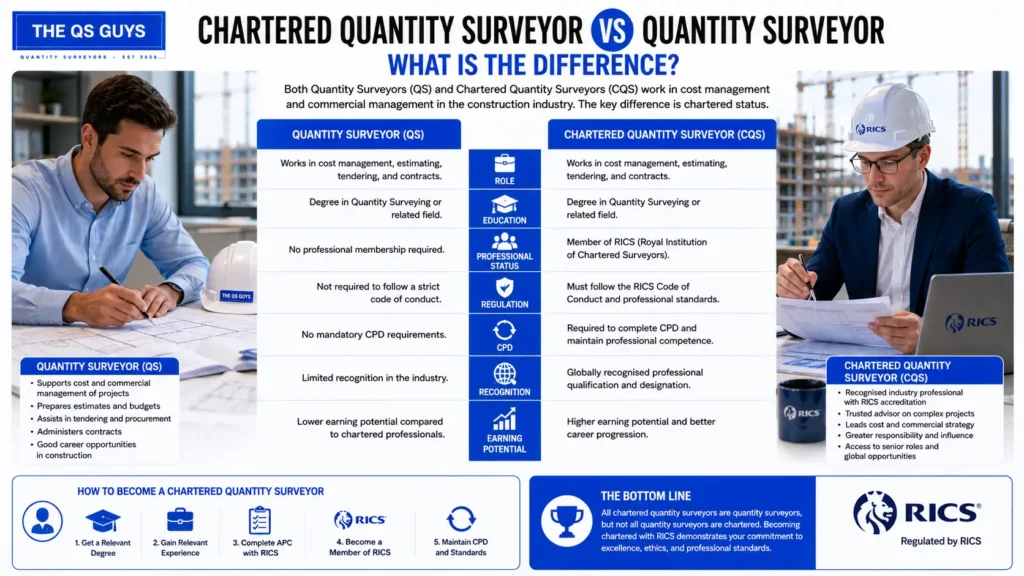
Chartered Quantity Surveyor vs Quantity Surveyor: What’s the Difference?
While both quantity surveyors and chartered quantity surveyors perform similar core duties, there is an important distinction between the two roles. A quantity surveyor focuses on managing construction costs, contracts, procurement, and financial planning throughout a project. A chartered quantity surveyor has gone a step further by achieving professional recognition through the Royal Institution of Chartered Surveyors (RICS). This additional accreditation demonstrates a higher level of professional competence, industry knowledge, and commitment to maintaining professional standards. Understanding the difference can help aspiring professionals make informed decisions about their career development and long-term goals.
What Is Chartered Status?
Chartered status is a professional designation awarded to individuals who have successfully met the standards set by RICS. It is widely recognised throughout the UK construction industry and internationally as a mark of excellence and professional credibility.
To become chartered, a quantity surveyor typically completes a relevant qualification, gains practical industry experience, and passes the Assessment of Professional Competence (APC). This process evaluates technical knowledge, professional judgement, ethics, and practical application of industry standards.
Chartered status shows that a professional has demonstrated the skills and expertise required to provide high-quality advice and services. It also signals a commitment to ongoing learning and professional development throughout their career.
Benefits of Becoming MRICS
Achieving MRICS status, which stands for Member of the Royal Institution of Chartered Surveyors, can provide significant professional and personal benefits. Many employers, clients, and industry stakeholders view MRICS accreditation as evidence of competence and reliability.
Some of the key benefits include:
- Professional Recognition: MRICS status demonstrates that you have met rigorous industry standards and possess recognised professional qualifications.
- Industry Credibility: Clients and employers often place greater trust in chartered professionals because their knowledge and experience have been independently assessed.
- Global Opportunities: RICS is recognised internationally, which can create opportunities to work on projects in different countries and markets.
- Professional Development: Members gain access to training resources, industry updates, networking opportunities, and continuing professional development programmes.
- Competitive Advantage: Chartered status can help professionals stand out when applying for roles, promotions, or specialist positions.
For many quantity surveyors, obtaining MRICS status is considered a major career milestone that enhances both professional reputation and long-term prospects.
Career and Salary Advantages
One of the most appealing reasons to pursue chartered status is the potential for improved career progression and earning potential. While non-chartered quantity surveyors can build successful careers, chartered professionals often have access to a wider range of senior-level opportunities.
Employers frequently prefer chartered candidates for leadership positions because the accreditation demonstrates a higher level of technical expertise and professional responsibility. As a result, chartered quantity surveyors may progress more quickly into roles such as Senior Quantity Surveyor, Commercial Manager, Cost Consultant, or Commercial Director.
Salary expectations can also differ between chartered and non-chartered professionals. While earnings vary depending on experience, location, and sector, MRICS-qualified surveyors often command higher salaries due to their recognised qualifications and professional standing. Chartered status can also strengthen a professional’s position during salary negotiations and promotion reviews.
In addition to financial benefits, chartered professionals may have greater opportunities to work on large-scale, complex, or high-value projects where employers and clients seek advanced expertise.
Employer Expectations
Many employers expect quantity surveyors to continuously develop their technical knowledge and commercial understanding throughout their careers. For professionals seeking advancement, working towards chartered status is often viewed as a natural progression.
Employers typically look for the following qualities when evaluating quantity surveyors:
- Technical Competence: Strong knowledge of cost management, procurement, contracts, and construction processes.
- Commercial Awareness: The ability to identify financial risks, manage budgets, and contribute to project profitability.
- Professional Conduct: Ethical decision-making, accountability, and adherence to recognised industry standards.
- Communication Skills: Confidence when working with clients, contractors, consultants, and project teams.
- Commitment to Development: A willingness to pursue additional qualifications, training, and professional accreditation.
While chartered status may not be mandatory for every quantity surveying role, many organisations actively encourage employees to achieve MRICS accreditation because it strengthens both individual performance and organisational credibility.
Whether you choose to remain a quantity surveyor or work towards becoming a chartered quantity surveyor, both career paths offer rewarding opportunities within the UK construction industry. However, obtaining chartered status can enhance professional recognition, expand career options, and provide a stronger foundation for long-term success in an increasingly competitive market.
Common Challenges New Quantity Surveyors Face
Starting a career in quantity surveying can be both exciting and demanding. While the profession offers strong career prospects and opportunities for growth, new quantity surveyors often face several challenges as they transition from education into the workplace. From managing multiple responsibilities to understanding complex contracts and controlling project costs, there is a significant amount to learn during the early stages of a career. Developing practical skills, building confidence, and gaining real-world experience are all essential parts of becoming a successful quantity surveyor.
Managing Multiple Projects
One of the biggest challenges new quantity surveyors encounter is learning how to manage several projects at the same time. In many organisations, quantity surveyors are responsible for supporting multiple construction projects that may be at different stages of completion. Each project has its own budget, deadlines, stakeholders, and commercial requirements.
Effective organisation is essential for keeping track of responsibilities and ensuring that important tasks are completed on time. New professionals must learn how to prioritise workloads, maintain accurate records, and communicate effectively with project teams.
Some practical strategies that help when managing multiple projects include:
- Time Management: Create structured schedules and allocate time for key tasks, meetings, and reporting requirements.
- Task Prioritisation: Focus on urgent and high-impact activities first while ensuring routine responsibilities are not overlooked.
- Documentation Control: Maintain organised project records to improve efficiency and reduce the risk of errors.
- Communication Skills: Keep clients, contractors, and internal teams informed about project developments and financial updates.
As experience grows, managing multiple projects becomes more manageable, but strong organisational habits developed early in a career can have a lasting impact on professional success.
Understanding Construction Contracts
Construction contracts form the foundation of commercial relationships within the building industry. For many new quantity surveyors, understanding contract terminology, obligations, and procedures can initially feel overwhelming.
Contracts define the rights and responsibilities of everyone involved in a project, including clients, contractors, consultants, and suppliers. They also establish how payments are made, how disputes are handled, and what happens when changes occur during construction.
New quantity surveyors should spend time becoming familiar with commonly used contract forms and learning how they affect project delivery. A solid understanding of contracts helps minimise risk and supports better commercial decision-making.
Important areas to understand include:
- Payment Provisions: Understanding how payment schedules, valuations, and final accounts are managed.
- Contract Variations: Learning how changes to project scope affect costs and contractual obligations.
- Risk Allocation: Identifying which party is responsible for specific project risks.
- Dispute Resolution: Understanding the processes used to resolve disagreements between project stakeholders.
Developing contract knowledge early in a career provides a strong foundation for handling more complex commercial responsibilities in the future.
Budget Pressures and Cost Control
Managing project finances is a core responsibility of a quantity surveyor, which means budget pressures are a regular part of the job. Construction projects often face challenges such as rising material prices, labour shortages, design changes, and unforeseen site conditions that can affect overall costs.
New quantity surveyors must learn how to monitor budgets carefully while helping project teams maintain financial control. This requires attention to detail, accurate forecasting, and the ability to identify potential issues before they become significant problems.
Effective cost-control practices often include:
- Cost Monitoring: Regularly reviewing project expenditure against approved budgets.
- Financial Forecasting: Predicting future costs to help project teams make informed decisions.
- Value Engineering: Identifying opportunities to improve efficiency without compromising quality.
- Risk Assessment: Recognising financial risks early and developing strategies to minimise their impact.
Strong financial management skills become increasingly important as quantity surveyors take on larger and more complex projects throughout their careers.
Building Industry Experience
While education provides valuable theoretical knowledge, practical experience is what transforms a graduate into a capable quantity surveyor. Many new professionals find that applying classroom concepts to real construction projects requires time, patience, and ongoing learning.
Industry experience helps quantity surveyors develop commercial awareness, understand project workflows, and build confidence when dealing with clients and contractors. Exposure to different project types also broadens technical knowledge and improves problem-solving abilities.
Ways to build valuable industry experience include:
- Work Placements: Participating in internships and placement opportunities during education.
- Graduate Programmes: Joining structured development programmes offered by construction and consultancy firms.
- Mentorship: Learning from experienced quantity surveyors who can provide guidance and practical insights.
- Professional Development: Attending industry events, training sessions, and networking opportunities.
Building experience is an ongoing process that continues throughout a quantity surveyor’s career. The more exposure professionals gain to different projects, contracts, and commercial situations, the more confident and effective they become in their role.
Although the early stages of a quantity surveying career can present challenges, each obstacle provides an opportunity to develop valuable skills and professional knowledge. By staying committed to learning, gaining practical experience, and building strong commercial awareness, new quantity surveyors can establish a solid foundation for long-term success in the UK construction industry.
If you are serious about building a successful career in quantity surveying, now is the perfect time to take the next step. Explore accredited training pathways, understand the qualifications employers value most, and gain insights from experienced industry professionals who understand the realities of the UK construction sector. With the right guidance and preparation, you can confidently start your journey toward a rewarding and respected profession with long term career growth and excellent earning potential.
References
- How to Become a Quantity Surveyor in the UK (Definitive Guide)
https://www.surveyorsuccess.co.uk/article/how-to-become-a-quantity-surveyor-in-the-uk - Quantity Surveyor Career Profile | National Careers Service
https://nationalcareers.service.gov.uk/job-profiles/quantity-surveyor - Pathway Guide Quantity Surveying and Construction | RICS
https://www.rics.org/content/dam/ricsglobal/documents/join-rics/qs_and_construction.pdf - Quantity Surveyor Job Profile | Prospects.ac.uk
https://www.prospects.ac.uk/job-profiles/quantity-surveyor/ - What Is a Quantity Surveyor? | RICS Careers Guide
https://www.rics.org/surveyor-careers/surveying/what-surveyors-do/what-is-a-quantity-surveyor

FAQs: About How To Become A Quantity Surveyor In UK
What qualifications do I need to become a quantity surveyor in the UK?
Most quantity surveyors in the UK have a degree in Quantity Surveying, Construction Management, or a related subject. Alternatively, you can enter the profession through a degree apprenticeship. Many employers also value practical experience and professional accreditation through RICS.
Can I become a quantity surveyor without a university degree?
Yes, it is possible to become a quantity surveyor through an apprenticeship route. Degree apprenticeships allow you to gain industry experience while studying, making them an attractive option for those who want to earn while they learn.
How long does it take to become a quantity surveyor in the UK?
The timeframe depends on the route you choose. A university degree typically takes three to four years, while apprenticeships can take four to six years. Additional time may be required to gain professional accreditation and industry experience.
What does a quantity surveyor do on a daily basis?
A quantity surveyor manages construction costs, prepares estimates, monitors budgets, reviews contracts, and helps ensure projects remain financially viable. They work closely with clients, contractors, suppliers, and project managers throughout the construction process.
Is quantity surveying a good career in the UK?
Quantity surveying is considered a rewarding career due to strong demand, competitive salaries, and clear progression opportunities. The profession offers long-term stability and the chance to work on a wide range of construction and infrastructure projects.
What skills are required to become a successful quantity surveyor?
Successful quantity surveyors need strong analytical, financial, communication, and problem-solving skills. Attention to detail, commercial awareness, negotiation abilities, and a good understanding of construction processes are also important.
What is the average salary of a quantity surveyor in the UK?
Salaries vary based on experience, location, and employer. Graduate quantity surveyors often start with competitive entry-level salaries, while chartered and senior quantity surveyors can earn significantly higher incomes as they progress in their careers.
What is RICS and why is it important for quantity surveyors?
RICS stands for the Royal Institution of Chartered Surveyors. Achieving chartered status through RICS demonstrates professional competence, increases credibility, and can improve career opportunities and earning potential.
Are quantity surveyors in demand in the UK
Yes, quantity surveyors remain in demand due to ongoing construction, housing, commercial development, and infrastructure projects across the UK. Many employers actively seek qualified professionals with both technical knowledge and practical experience.
What career progression opportunities are available for quantity surveyors
Quantity surveyors can advance into senior quantity surveyor, commercial manager, cost consultant, project director, or leadership positions. Some professionals also specialise in sectors such as infrastructure, residential development, or international construction projects.
Conclusion
Becoming a quantity surveyor in the UK offers a rewarding career path for individuals who enjoy combining financial expertise with the practical side of construction and development projects. There are several education pathways available, including university degrees, degree-apprenticeships, and conversion courses for career changers, making the profession accessible to people from different backgrounds. Alongside formal qualifications, gaining hands-on industry experience is essential for developing the commercial awareness, technical knowledge, and problem-solving skills needed to succeed in real-world construction environments. Professional accreditation through organisations such as the Royal Institution of Chartered Surveyors (RICS) can further strengthen your credibility, improve career prospects, and increase earning potential. As your experience grows, opportunities can expand into senior-level positions, commercial management roles, consultancy work, and leadership positions across a wide range of sectors. If you are ready to take the next step, start by researching accredited courses, exploring apprenticeship programmes, seeking practical industry experience, and learning more about RICS membership and continuing professional development opportunities. Whether you are beginning your career journey or considering a career change, investing in the right training, industry resources, and professional guidance can help you build a strong foundation for long-term success in quantity surveying.