Best Building Estimating Software UK For Contractors

Welcome to our guide to the best building estimating software UK businesses can use to improve cost accuracy, streamline tendering, and manage construction projects more effectively. Whether you are a builder, contractor, quantity surveyor, or construction company owner, choosing the right estimating software can make a significant difference to your profitability and project success. With so many solutions available, finding a platform that matches your workflow, budget, and business goals can be challenging. In this guide, we compare the leading building estimating software options in the UK, explore the features that matter most, and explain how the right tool can help you create accurate estimates, reduce costly errors, save time, and win more work in an increasingly competitive construction market.
The best building estimating software UK construction professionals use includes CostX, Buildxact, Causeway Estimating, ConQuest Estimating, Bluebeam Revu, and Cubit. These platforms help builders, contractors, and quantity surveyors create accurate cost estimates, manage tenders, perform digital takeoffs, and improve project profitability through faster and more reliable construction costing.
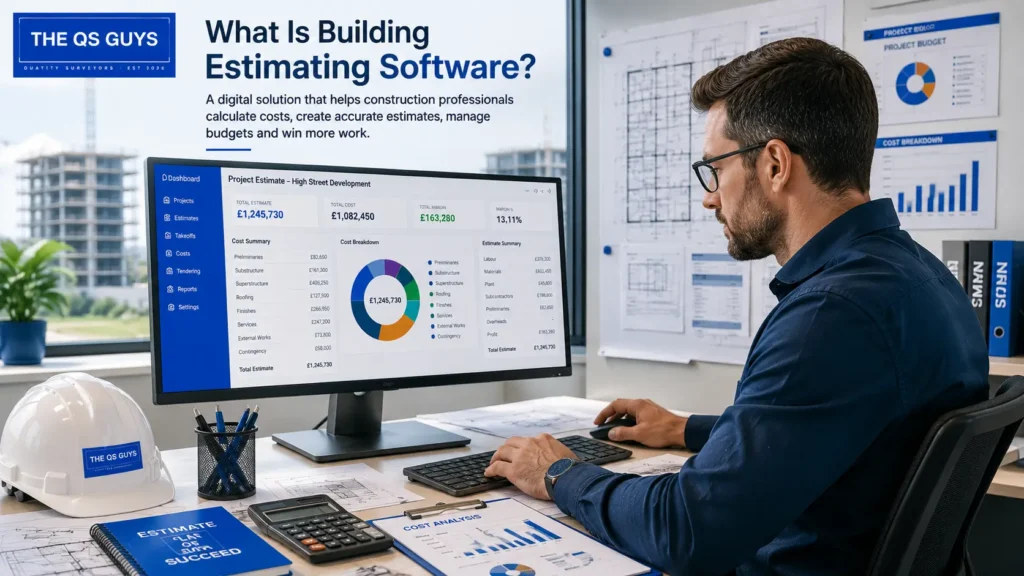
What Is Building Estimating Software?
Building estimating software is a digital tool designed to help construction professionals calculate project costs, prepare accurate quotes, manage budgets, and create competitive tenders. Instead of relying on spreadsheets or manual calculations, builders and contractors can use estimating software to streamline the entire pricing process. Modern construction estimating software combines cost data, material quantities, labour rates, and project requirements into one platform, making it easier to produce reliable estimates while reducing the risk of human error. For businesses operating in a competitive market, accurate estimating plays a major role in maintaining profitability and delivering projects within budget.
How Building Estimating Software Works
Building estimating software simplifies complex calculations by bringing together several key estimating functions into one system. This allows construction professionals to create detailed cost estimates more efficiently while maintaining consistency across projects.
Cost Calculations
At its core, estimating software performs cost calculations based on project specifications. Users can enter quantities, labour rates, material costs, subcontractor expenses, and overheads to generate a complete project estimate.
- Improved Accuracy: Automated calculations reduce the likelihood of mathematical errors that can occur with manual estimating.
- Time Savings: Cost estimates can be produced significantly faster compared to traditional spreadsheet methods.
- Consistent Pricing: Standardised pricing templates help ensure estimates remain consistent across multiple projects.
Material Takeoffs
Material takeoffs involve calculating the quantities of materials required for a project. Many modern estimating platforms include digital takeoff tools that allow users to measure directly from drawings and plans.
- Quantity Measurement: Materials such as concrete, timber, steel, and roofing products can be measured accurately.
- Reduced Waste: More precise calculations help minimise material over-ordering.
- Better Planning: Contractors gain a clearer understanding of project requirements before work begins.
Labour Costing
Labour often represents one of the largest construction expenses. Estimating software helps businesses calculate labour requirements based on project scope and workforce productivity.
- Resource Allocation: Teams can estimate the number of workers needed for specific tasks.
- Cost Forecasting: Labour expenses can be calculated before project commencement.
- Productivity Tracking: Historical data can help improve future labour estimates.
Project Budgeting
Estimating software supports project budgeting by combining all cost categories into a single financial overview.
- Budget Visibility: Users can identify major cost drivers early in the planning stage.
- Financial Control: Budget forecasts help reduce the risk of unexpected expenses.
- Decision Support: Contractors can compare alternative materials or construction methods before finalising plans.
Tender Preparation
Preparing tenders manually can be time-consuming and prone to errors. Estimating software simplifies this process by generating professional and detailed tender documents.
- Professional Presentation: Tender submissions appear more organised and credible.
- Faster Turnaround: Businesses can respond to opportunities more quickly.
- Competitive Pricing: Accurate estimates support stronger and more profitable bids.
Why Accurate Estimating Matters in Construction
Accurate estimating is one of the most important aspects of successful project management. A poorly prepared estimate can affect profitability, project timelines, client relationships, and business growth.
Preventing Budget Overruns
Budget overruns often occur when project costs are underestimated at the planning stage. Accurate estimating helps identify potential expenses before construction begins.
- Realistic Cost Planning: Estimates reflect actual project requirements.
- Risk Management: Potential financial challenges can be identified early.
- Client Confidence: Accurate budgets create more transparent project expectations.
Reducing Costly Mistakes
Construction projects involve numerous variables, including labour, materials, equipment, and subcontractors. Errors in estimating can lead to significant financial losses.
- Fewer Calculation Errors: Automated systems reduce manual mistakes.
- Better Data Management: Centralised information improves consistency.
- Reduced Rework: Accurate planning helps avoid unexpected shortages and delays.
Improving Bid Success Rates
Winning work requires balancing competitive pricing with sustainable profit margins. Accurate estimates help businesses submit realistic and attractive tenders.
- Competitive Positioning: Contractors can price projects with greater confidence.
- Enhanced Credibility: Clients often prefer detailed and transparent proposals.
- Faster Responses: Quick turnaround times can provide an advantage during tendering.
Supporting Project Profitability
Profitability depends on understanding project costs before work begins. Estimating software helps businesses protect margins and improve financial outcomes.
- Margin Protection: Hidden costs are less likely to be overlooked.
- Improved Forecasting: Businesses can plan resources more effectively.
- Long-Term Growth: Consistent profitability supports business expansion and stability.
Who Uses Building Estimating Software?
Building estimating software serves a wide range of construction professionals. Each user group benefits from improved accuracy, efficiency, and financial control.
Builders
Builders use estimating software to prepare quotes, manage project budgets, and monitor costs throughout construction projects.
- Faster Quoting: Generate estimates more efficiently.
- Improved Accuracy: Reduce pricing errors.
- Better Client Communication: Provide detailed and professional proposals.
Main Contractors
Main contractors often manage multiple trades, suppliers, and project stages. Estimating software helps coordinate complex project costs.
- Comprehensive Cost Management: Consolidate multiple cost categories.
- Project Oversight: Track financial performance throughout the build.
- Bid Preparation: Create detailed tender submissions for large-scale projects.
Subcontractors
Subcontractors use estimating software to price specialised services such as electrical work, plumbing, roofing, or concrete construction.
- Specialised Pricing: Build estimates based on trade-specific requirements.
- Efficiency Improvements: Reduce administrative workload.
- Consistent Quoting: Maintain pricing accuracy across projects.
Quantity Surveyors
Quantity surveyors rely heavily on accurate measurements and cost analysis. Estimating software helps streamline these responsibilities.
- Detailed Cost Planning: Produce accurate project cost forecasts.
- Digital Measurement Tools: Improve quantity takeoff efficiency.
- Data Analysis: Evaluate project costs using real-time information.
Construction Project Managers
Project managers use estimating software to monitor budgets, track costs, and support project planning decisions.
- Budget Monitoring: Compare actual costs against estimates.
- Resource Planning: Allocate labour and materials more effectively.
- Financial Reporting: Maintain visibility across project expenditures.
Choosing the right building estimating software can make a significant difference to project accuracy, efficiency, and profitability. Whether you are a builder preparing quotes, a quantity surveyor managing costs, or a project manager overseeing budgets, the right solution helps simplify complex calculations and supports better decision-making throughout the construction process.
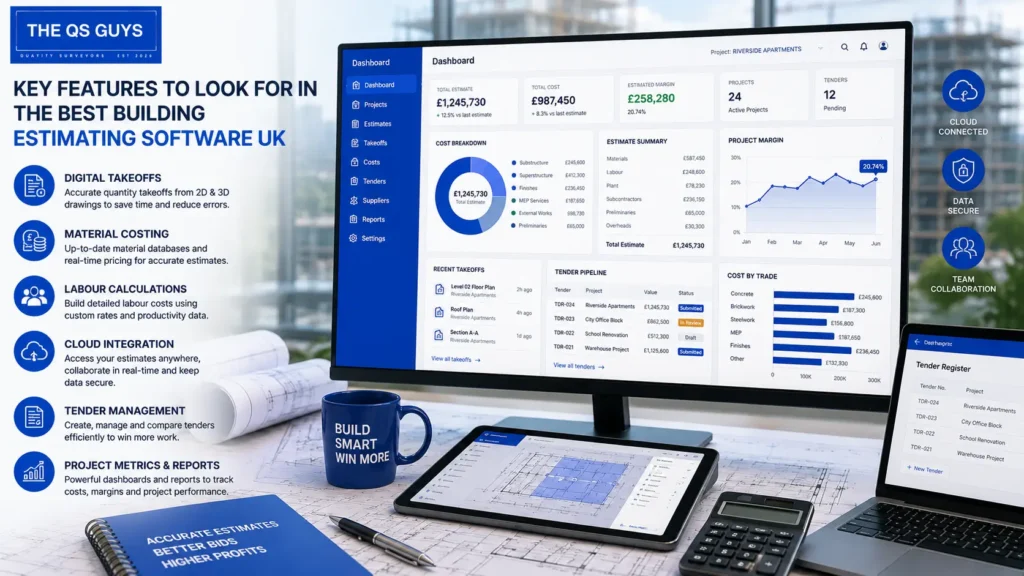
Key Features To Look For In The Best Building Estimating Software UK
Choosing the best building estimating software UK construction professionals can rely on involves more than comparing prices or reviewing feature lists. The right solution should improve estimating accuracy, reduce administrative workload, and support better decision-making throughout the project lifecycle. Whether you are a small builder, a quantity surveyor, or a large construction company, understanding the key features that matter most will help you invest in software that delivers long-term value and supports business growth.
Digital Takeoff and Quantity Measurement Tools
Digital takeoff tools are among the most valuable features in modern construction estimating software. They allow users to measure directly from digital plans, eliminating many of the manual processes that traditionally consumed significant time and increased the risk of errors.
Measuring Directly from Plans
Instead of manually reviewing paper drawings and calculating measurements by hand, digital takeoff software allows estimators to work directly from electronic plans. This creates a more efficient workflow and improves consistency across projects.
- Improved Accuracy: Digital measurements help reduce human error and ensure quantities are calculated consistently across different project stages.
- Simplified Revisions: When project drawings are updated, estimators can quickly adjust measurements without restarting the entire takeoff process.
- Better Documentation: Digital records provide a clear audit trail that can be reviewed, verified, and shared with stakeholders when needed.
Faster Quantity Calculations
Speed is critical when preparing estimates and responding to tender opportunities. Digital takeoff tools help construction professionals generate accurate quantity calculations in a fraction of the time required by manual methods.
- Time Savings: Automated calculations allow estimators to complete projects faster and focus on analysis rather than data entry.
- Greater Productivity: Teams can handle more tenders and project opportunities without increasing staffing requirements.
- Consistent Results: Standardised measurement methods help maintain accuracy across multiple estimators and projects.
Labour and Material Cost Databases
Accurate labour and material pricing forms the foundation of every successful construction estimate. A strong estimating platform should include tools that help businesses maintain current pricing information and respond quickly to changing market conditions.
Real-Time Cost Tracking
Construction costs can fluctuate significantly due to market conditions, labour shortages, and supply chain disruptions. Real-time tracking tools help estimators work with current information rather than outdated assumptions.
- Current Cost Visibility: Access to updated pricing reduces the likelihood of underestimating project expenses.
- Better Budget Control: Accurate cost data helps businesses protect profit margins and improve project forecasting.
- Reduced Financial Risk: Estimates based on current market conditions provide greater confidence when submitting tenders.
Supplier Pricing Integration
Many construction businesses work with multiple suppliers, each offering different pricing structures and product ranges. Software that integrates supplier pricing helps streamline the estimating process.
- Automatic Updates: Supplier costs can be refreshed without manual data entry.
- More Accurate Quotes: Current supplier pricing reduces the risk of pricing discrepancies.
- Stronger Purchasing Decisions: Comparing supplier costs helps identify cost-effective purchasing options.
UK Construction Pricing Libraries
Construction costs vary significantly across the UK. Regional labour rates, material availability, and local market conditions can all influence project pricing. Estimating software designed for UK users should include pricing resources that reflect these realities.
Regional Pricing Considerations
A project in London often carries different cost implications than a similar project in Manchester, Birmingham, or Glasgow. Regional pricing functionality helps estimators account for these differences.
- Location-Specific Accuracy: Estimates reflect local labour and material costs.
- More Competitive Tendering: Pricing remains realistic and aligned with regional market expectations.
- Improved Cost Planning: Businesses can forecast expenses more accurately when working across multiple locations.
UK-Specific Construction Rates
Software developed for the UK construction sector often includes databases and cost libraries tailored to local industry standards.
- Relevant Market Data: Estimators can work with pricing information designed specifically for UK construction projects.
- Industry Alignment: Cost calculations better reflect common construction methods and materials used throughout the UK.
- Reliable Benchmarking: Teams can compare estimates against recognised industry rates and standards.
Tendering and Quotation Management
Winning profitable work depends on producing accurate, professional, and timely quotations. Modern estimating software often includes dedicated tender management tools that simplify this process.
Professional Quote Generation
Professional presentation plays an important role when submitting tenders and quotations. Well-structured proposals can improve client confidence and support stronger business relationships.
- Consistent Branding: Quotations maintain a professional appearance across all projects.
- Clear Cost Breakdown: Clients can easily understand what is included in the estimate.
- Faster Preparation: Automated templates reduce administrative effort while maintaining quality.
Bid Management Capabilities
Managing multiple tenders simultaneously can become challenging without a structured system. Bid management tools help businesses track opportunities and improve tender workflows.
- Centralised Information: All tender-related documents and communications remain organised.
- Deadline Management: Important submission dates are easier to track.
- Performance Analysis: Businesses can review win rates and identify opportunities for improvement.
Cloud-Based Accessibility
Cloud-based estimating software has become increasingly popular because it provides flexibility, accessibility, and collaboration opportunities that traditional desktop solutions cannot match.
Multi-User Collaboration
Construction projects often involve estimators, project managers, directors, and administrative staff working together. Cloud-based systems make collaboration much easier.
- Real-Time Updates: Team members can access the latest information without waiting for files to be shared.
- Improved Communication: Multiple users can contribute to estimates and project planning activities.
- Greater Efficiency: Teams spend less time managing files and more time focusing on project delivery.
Remote Project Access
Modern construction businesses often operate across multiple sites and locations. Remote access allows teams to work effectively from virtually anywhere.
- Flexible Working: Staff can access project information from the office, home, or construction site.
- Faster Decision-Making: Critical project data remains available whenever it is needed.
- Business Continuity: Cloud-based systems reduce dependence on a single office location or local server.
Integration with Accounting and Project Management Software
Construction estimating software delivers the greatest value when it connects seamlessly with other business systems. Integration reduces duplicate work and creates a more connected workflow from estimate to project completion.
Sage
Sage remains one of the most widely used accounting platforms within the UK construction industry. Integration between estimating and accounting systems helps improve financial management.
- Streamlined Data Flow: Information moves directly between systems without repeated manual entry.
- Improved Financial Visibility: Project costs can be tracked more accurately throughout delivery.
- Reduced Administration: Staff spend less time managing financial records.
Xero
Many small and medium-sized construction companies use Xero because of its user-friendly cloud-based functionality.
- Real-Time Financial Tracking: Businesses can monitor costs, invoices, and profitability more effectively.
- Simplified Accounting Processes: Financial data remains organised and accessible.
- Enhanced Reporting: Management teams gain clearer insight into business performance.
QuickBooks
QuickBooks integration helps businesses maintain accurate financial records while reducing manual workload.
- Accurate Cost Tracking: Project expenses can be monitored throughout the project lifecycle.
- Improved Efficiency: Estimating and accounting functions work together more effectively.
- Better Financial Planning: Decision-makers gain access to reliable project data.
Construction Management Platforms
Many estimating solutions integrate with wider construction management platforms to support end-to-end project delivery.
- Connected Workflows: Information flows seamlessly from estimating to project execution.
- Centralised Project Data: Teams work from a single source of information.
- Improved Project Oversight: Managers gain better visibility into budgets, schedules, and performance metrics.
The best building estimating software UK construction professionals choose is not simply the platform with the longest feature list. The most effective solutions combine accurate estimating, practical workflows, reliable cost data, and strong integration capabilities to help businesses work more efficiently, improve profitability, and confidently manage projects from initial estimate to final completion.
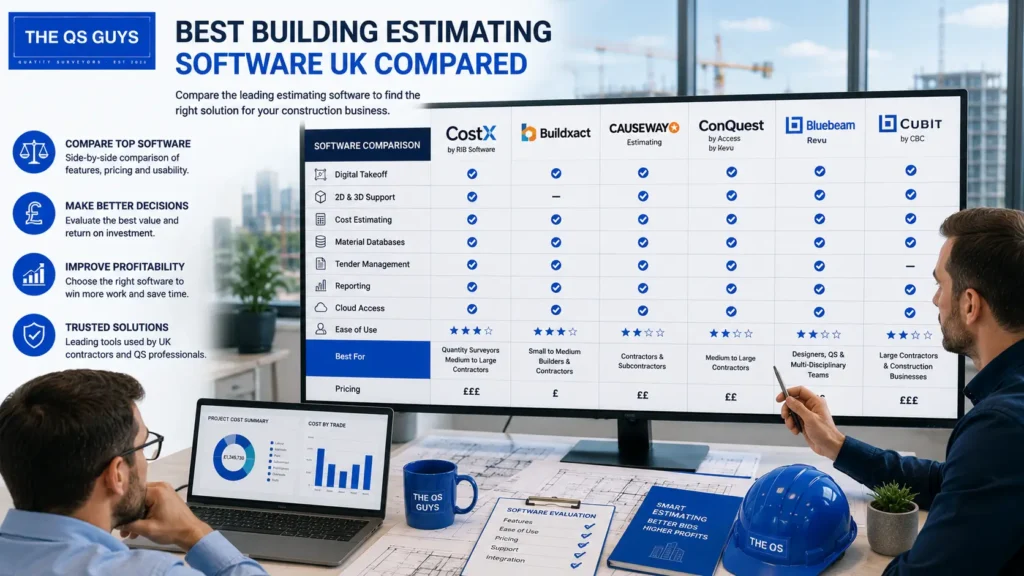
Best Building Estimating Software UK Compared
Choosing the best building estimating software UK construction professionals can rely on depends on several factors, including company size, project complexity, budget, and workflow requirements. Some platforms focus on detailed cost estimation and quantity surveying, while others combine estimating with project management, takeoff tools, and financial tracking. Understanding the strengths and limitations of each solution can help contractors, builders, and quantity surveyors select software that supports accurate construction costing and long-term business growth.
Causeway Estimating
Causeway Estimating is one of the most established construction estimating solutions available in the UK. It is widely used by contractors seeking accurate cost planning, tender preparation, and estimating consistency across projects.
Key Features
- Comprehensive Cost Database: Includes detailed pricing information that helps estimators produce accurate and consistent project costs.
- Tender Management Tools: Supports the creation and management of competitive tenders with detailed cost breakdowns.
- Integration Capabilities: Connects with other construction management and financial systems to streamline workflows.
- Reporting Functions: Generates detailed reports that support decision-making and project analysis.
Best For
Causeway Estimating is best suited for medium-sized to large construction companies, civil engineering firms, and contractors handling complex projects that require detailed cost control and structured estimating processes.
Pros and Limitations
- Advantages: Strong UK market presence, detailed estimating functionality, excellent reporting capabilities, and scalable solutions for growing businesses.
- Limitations: The software may require training for new users and can represent a significant investment for smaller companies.
ConQuest Estimating
ConQuest Estimating has built a strong reputation among UK construction professionals for delivering accurate cost estimates while simplifying the tendering process.
Key Features
- Cost Planning Tools: Enables accurate project budgeting and cost forecasting.
- Flexible Estimating Templates: Allows businesses to standardise estimating procedures across teams.
- Revision Tracking: Helps users manage estimate changes and maintain version control.
- Custom Reporting: Produces tailored reports to support project planning and financial analysis.
Best For
ConQuest Estimating is ideal for contractors, quantity surveyors, and estimators who require detailed control over project costing and tender preparation.
Pros and Limitations
- Advantages: Strong estimating functionality, customisable workflows, and detailed reporting options.
- Limitations: The user interface may feel dated compared to some newer cloud-based platforms, and setup can take time for larger organisations.
Bluebeam Revu
Bluebeam Revu is widely recognised for its digital takeoff capabilities and document management features. While not a dedicated estimating platform, it is often used alongside estimating software to improve quantity measurement accuracy.
Key Features
- Digital Takeoff Tools: Allows users to measure quantities directly from electronic plans and drawings.
- Document Collaboration: Supports team collaboration through shared markups and annotations.
- PDF Management: Simplifies reviewing, editing, and organising project documents.
- Custom Measurement Tools: Improves efficiency when performing repetitive quantity takeoffs.
Best For
Bluebeam Revu is best suited for contractors, estimators, architects, and quantity surveyors who regularly work with digital construction drawings and require accurate takeoff measurements.
Pros and Limitations
- Advantages: Excellent takeoff functionality, strong collaboration features, and efficient document management.
- Limitations: It is not a complete estimating solution and often needs to be paired with dedicated estimating software.
Buildxact
Buildxact is a cloud-based construction estimating and project management platform designed specifically for residential builders, remodelers, and small construction businesses.
Key Features
- Cloud-Based Access: Enables users to work from any location with internet access.
- Estimating and Quoting Tools: Creates professional estimates and client proposals quickly.
- Supplier Integration: Connects with suppliers to improve pricing accuracy.
- Project Management Features: Combines estimating with scheduling and job tracking tools.
Best For
Buildxact is particularly suitable for small builders, renovation contractors, and residential construction companies seeking an all-in-one solution.
Pros and Limitations
- Advantages: User-friendly interface, cloud-based accessibility, and integrated project management features.
- Limitations: Larger contractors managing highly complex projects may require more advanced estimating functionality.
CostX
CostX is one of the most recognised construction estimating and quantity surveying platforms used throughout the UK and internationally. It combines advanced takeoff tools with detailed estimating capabilities.
Key Features
- Integrated Takeoff and Estimating: Combines quantity measurement and cost estimation within a single platform.
- 3D BIM Compatibility: Supports Building Information Modelling workflows.
- Detailed Cost Analysis: Produces highly accurate project budgets and forecasts.
- Quantity Surveying Tools: Provides extensive functionality for professional quantity surveyors.
Best For
CostX is best suited for quantity surveyors, large contractors, commercial construction companies, and organisations handling complex construction projects.
Pros and Limitations
- Advantages: Highly accurate estimating tools, advanced takeoff functionality, and strong BIM integration.
- Limitations: The learning curve can be steep for new users, and licensing costs may be higher than some alternatives.
Esticom
Esticom is a cloud-based construction estimating platform that focuses on simplifying the estimating process while maintaining accuracy and efficiency.
Key Features
- Digital Takeoff Tools: Enables fast quantity measurement directly from digital plans.
- Cloud-Based Collaboration: Allows teams to access project information from multiple locations.
- Estimate Automation: Reduces manual calculations and repetitive tasks.
- Cost Tracking Features: Helps monitor project budgets and estimate accuracy.
Best For
Esticom is well-suited for contractors, speciality trades, and businesses seeking a straightforward cloud-based estimating solution.
Pros and Limitations
- Advantages: Easy to use, cloud-based accessibility, and efficient takeoff tools.
- Limitations: Some advanced enterprise-level estimating features may not be as extensive as those offered by larger platforms.
Cubit Estimating
Cubit Estimating is designed specifically for construction estimating and quantity takeoff. It provides a practical balance between functionality and usability, making it popular among contractors and estimators.
Key Features
- Integrated Takeoff and Estimating: Connects quantity measurements directly to cost estimates.
- Cost Database Management: Helps maintain consistent pricing across projects.
- Estimate Revisions: Simplifies updating estimates when project requirements change.
- Reporting Tools: Generates professional reports for clients and internal stakeholders.
Best For
Cubit Estimating is ideal for contractors, estimators, and quantity surveyors seeking a dedicated estimating platform without unnecessary complexity.
Pros and Limitations
- Advantages: Strong estimating accuracy, efficient takeoff integration, and user-friendly workflows.
- Limitations: Some businesses may find fewer third-party integrations compared to larger enterprise solutions.
The best building estimating software UK companies choose ultimately depends on their specific business requirements, project types, and growth plans. While large contractors may benefit from advanced platforms such as CostX or Causeway Estimating, smaller builders often find solutions like Buildxact or Esticom more practical. Taking the time to compare features, test demonstrations, and evaluate long-term value can help ensure you select software that improves estimating accuracy, streamlines operations, and supports profitable project delivery.
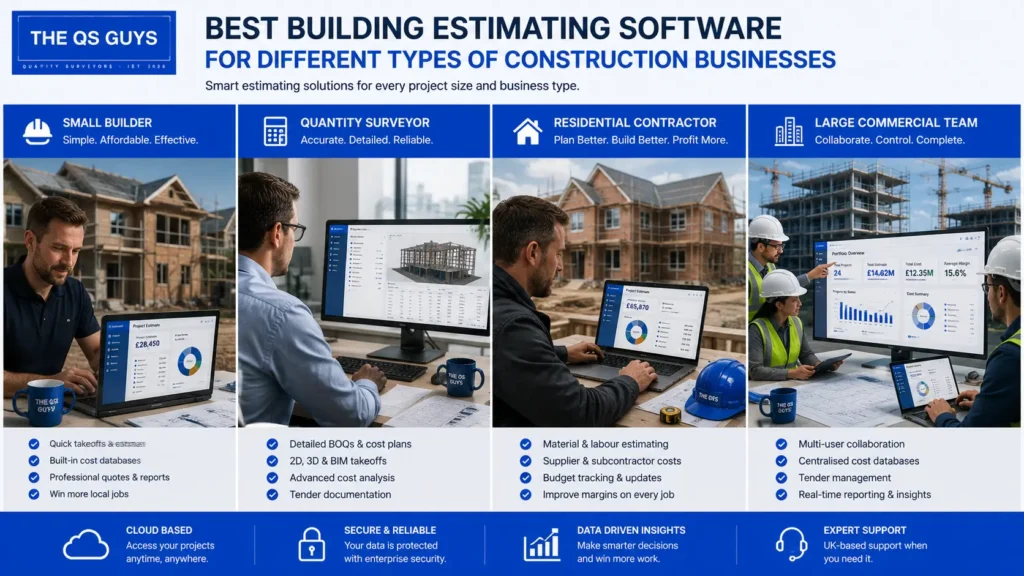
Best Building Estimating Software For Different Types Of Construction Businesses
Not every construction business has the same estimating requirements. A sole trader handling home renovations will have different priorities than a large contractor managing multi-million-pound developments. The best building estimating software UK companies choose often depends on project complexity, team size, reporting needs, and budget. Understanding which platforms suit specific business types can help you invest in software that improves efficiency, supports growth, and delivers accurate cost estimates without adding unnecessary complexity.
Best for Small Builders and Trades Businesses
Small builders, independent contractors, and trade professionals often need estimating software that is easy to use, affordable, and capable of producing accurate quotations quickly. Many smaller businesses do not have dedicated estimating departments, so simplicity and speed are usually top priorities.
Software such as Buildxact is often popular among small construction businesses because it combines estimating, quoting, scheduling, and job management in a single platform. This helps reduce administrative work while improving estimate accuracy.
When evaluating software for a small business, consider the following:
- Ease of Use: The software should be simple to learn without requiring extensive training.
- Fast Quote Creation: Quick estimating tools help businesses respond to enquiries faster and win more work.
- Cloud Access: Mobile-friendly platforms allow builders to create and update estimates from site or the office.
- Affordable Pricing: Subscription costs should align with business revenue and project volume.
- Basic Project Management: Integrated scheduling and task management can reduce the need for additional software.
For many small businesses, the goal is not finding the most advanced platform but selecting software that saves time and improves estimating consistency.
Best for Medium-Sized Construction Companies
Medium-sized construction companies often manage multiple projects simultaneously and require greater control over costs, resources, and project reporting. At this stage, estimating software becomes a critical part of operational efficiency rather than simply a quoting tool.
Platforms such as ConQuest Estimating and Causeway Estimating are frequently used by growing construction companies because they provide greater depth in cost planning, tender preparation, and reporting.
Key capabilities that benefit medium-sized firms include:
- Multi-Project Management: Allows estimators to work across several active tenders and projects.
- Custom Cost Databases: Enables businesses to maintain accurate labour and material rates.
- Reporting Functions: Generates detailed reports for management review and project planning.
- Team Collaboration: Supports multiple users working within a shared estimating environment.
- Integration Options: Connects estimating processes with accounting and project management systems.
For growing firms, investing in scalable estimating software can help maintain profitability while handling increased workloads.
Best for Large Contractors and Developers
Large contractors and property developers often manage complex projects involving multiple stakeholders, subcontractors, procurement teams, and project managers. Estimating software at this level must provide advanced functionality, detailed cost control, and enterprise-level reporting.
Solutions such as CostX and Causeway Estimating are commonly used by larger organisations due to their ability to manage extensive datasets, detailed cost analysis, and sophisticated estimating workflows.
Important features for larger businesses include:
- Advanced Cost Planning: Supports detailed project budgeting and forecasting.
- Enterprise Reporting: Provides management teams with comprehensive financial insights.
- Tender Management: Simplifies the preparation and evaluation of large-scale tenders.
- User Permissions: Controls access across departments and project teams.
- Data Consistency: Maintains standardised estimating practices across the organisation.
For larger companies, accurate estimating directly impacts profitability, project viability, and long-term financial performance.
Best for Quantity Surveyors
Quantity surveyors require estimating software that delivers precision, flexibility, and detailed measurement capabilities. Their role often involves preparing cost plans, conducting quantity takeoffs, and monitoring project expenditure throughout the construction lifecycle.
CostX is widely recognised within the quantity surveying profession because of its advanced digital takeoff and measurement functionality. The ability to measure directly from drawings and link quantities to cost databases can significantly improve efficiency.
Features particularly valuable to quantity surveyors include:
- Digital Takeoff Tools: Improve measurement accuracy and reduce manual calculations.
- Detailed Cost Breakdown Structures: Allow precise allocation of project costs.
- Measurement Flexibility: Supports a wide range of construction disciplines.
- Audit Trails: Provides transparency and traceability throughout the estimating process.
- Professional Reporting: Generates reports suitable for clients, consultants, and project stakeholders.
The right software can help quantity surveyors maintain accuracy while handling increasingly complex construction projects.
Best for Residential Construction Projects
Residential construction projects often involve unique client requirements, varying design specifications, and tight budgets. Builders working in this sector benefit from software that simplifies estimating while providing accurate material and labour forecasting.
Residential builders commonly use software such as Buildxact because it combines estimating with job management functions that support day-to-day operations.
Key benefits for residential construction include:
- Accurate Material Calculations: Helps reduce waste and unexpected costs.
- Client-Friendly Quotations: Produces clear and professional proposals.
- Budget Tracking: Helps monitor project spending throughout construction.
- Supplier Integration: Improves pricing accuracy and procurement efficiency.
- Scheduling Features: Assists with project planning and resource allocation.
For residential builders, efficiency and accuracy can improve client satisfaction and protect project margins.
Best for Commercial Construction Projects
Commercial construction projects typically involve larger budgets, stricter reporting requirements, and more complex project scopes. Estimating software must be capable of handling substantial quantities of data while supporting collaboration across multiple teams.
Platforms such as CostX, Causeway Estimating, and ConQuest Estimating are often preferred for commercial construction due to their advanced capabilities and scalability.
Commercial project requirements often include:
- Large-Scale Cost Planning: Supports detailed budgeting across multiple project phases.
- Tender Analysis: Assists with bid evaluation and subcontractor comparisons.
- Detailed Reporting: Provides accurate financial information for project stakeholders.
- Collaboration Tools: Enables communication between estimators, project managers, and procurement teams.
- Scalability: Handles complex projects without compromising performance.
Commercial contractors benefit from software that provides greater visibility into project costs while supporting informed decision-making throughout the construction process.
Choosing the best building estimating software ultimately comes down to understanding your business needs, project requirements, and growth plans. Whether you are a small builder looking for faster quotations or a large contractor managing complex developments, selecting software that aligns with your workflow can improve estimating accuracy, save valuable time, and support stronger financial outcomes across every project.
Building Estimating Software vs Manual Estimating
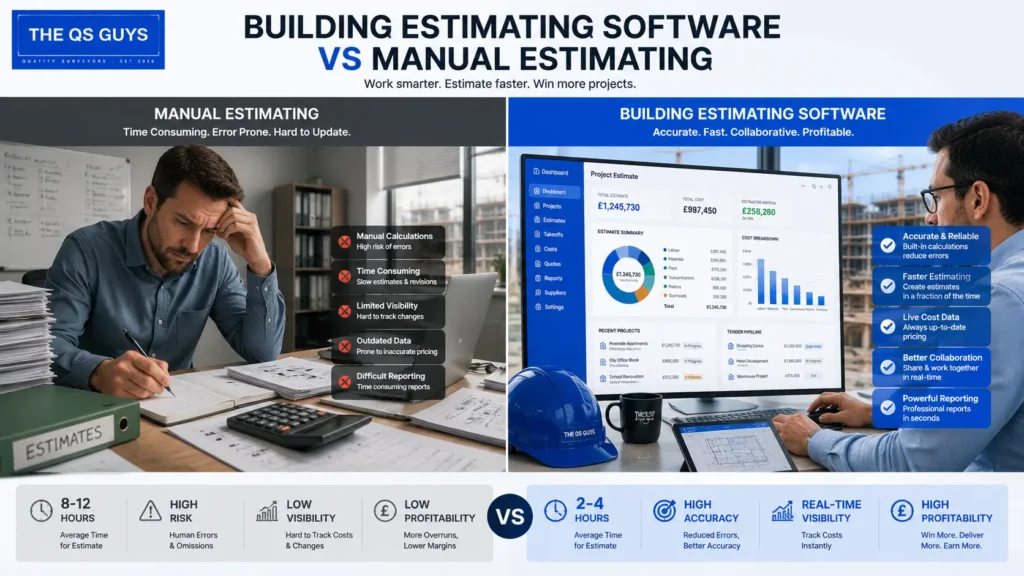
For many construction businesses, estimating remains one of the most important activities in the project lifecycle. A well-prepared estimate can protect profit margins, improve tender success rates, and help projects stay within budget. While some contractors still rely on spreadsheets or manual calculations, modern building estimating software offers tools that streamline the entire process. Understanding the differences between software-based and manual estimating can help businesses choose the approach that best supports their growth, accuracy, and operational efficiency.
Time Savings and Efficiency
One of the biggest advantages of building estimating software is the amount of time it saves compared to manual estimating methods. Creating estimates manually often involves reviewing drawings, measuring quantities, gathering supplier pricing, calculating labour costs, and compiling everything into a proposal. This process can take hours or even days depending on the size of the project.
Estimating software automates many of these tasks. Digital takeoff tools allow estimators to measure directly from plans, while built-in cost databases can instantly calculate material and labour expenses. Instead of manually updating multiple spreadsheets, users can make changes once and have the entire estimate updated automatically.
Some key efficiency benefits include:
- Faster Quote Preparation: Generate estimates and quotations in a fraction of the time required with manual methods.
- Automated Calculations: Reduce repetitive tasks by allowing the software to calculate totals, markups, and contingencies automatically.
- Improved Workflow Management: Store project information in one central location for easier access and collaboration.
- Reduced Administrative Work: Spend less time formatting documents and more time reviewing project details.
For construction companies that prepare multiple bids each week, these time savings can significantly improve productivity and allow teams to pursue more opportunities.
Accuracy and Error Reduction
Accuracy is critical in construction estimating because even a small mistake can affect project profitability. Manual estimating processes are more vulnerable to human error, particularly when handling large quantities of information across multiple spreadsheets and documents.
Common manual estimating mistakes include incorrect formulas, omitted items, duplicate entries, and outdated pricing information. These errors can lead to underpricing, overpricing, or unexpected project costs that affect overall business performance.
Building estimating software helps reduce these risks by providing structured workflows and automated calculations. Many platforms also allow users to maintain updated pricing libraries, ensuring estimates reflect current material and labour costs.
Benefits of improved accuracy include:
- Consistent Costing: Standardized pricing methods help create more reliable estimates across projects.
- Reduced Human Error: Automated calculations minimize the risk of mathematical mistakes.
- Better Quantity Measurements: Digital takeoff tools improve measurement precision compared to manual calculations.
- Improved Budget Forecasting: More accurate estimates support stronger project planning and financial management.
Greater accuracy not only protects profitability but also helps build trust with clients who expect realistic and dependable project pricing.
Cost Control Benefits
Effective cost control begins long before construction starts. Accurate estimating allows businesses to understand project expenses, identify risks, and allocate resources appropriately. Manual estimating methods can make it difficult to track changing costs or quickly adjust estimates when project requirements change.
Building estimating software provides better visibility into project costs from the outset. Users can compare pricing scenarios, apply markups consistently, and identify areas where costs may exceed budget targets.
Some important cost control advantages include:
- Real-Time Cost Updates: Adjust estimates quickly when material or labour prices change.
- Detailed Cost Breakdown: View individual cost categories to identify savings opportunities.
- Improved Margin Management: Monitor profitability throughout the estimating process.
- Risk Identification: Highlight potential budget concerns before submitting tenders.
By improving cost visibility and control, estimating software helps businesses make more informed decisions and reduce financial surprises during project delivery.
Scalability for Growing Construction Businesses
Manual estimating may be manageable for a small business handling a limited number of projects. As a company grows, however, estimating requirements often become more complex. More projects, larger teams, and higher tender volumes can quickly overwhelm manual systems.
Building estimating software provides a scalable solution that grows alongside the business. Cloud-based platforms allow multiple users to access project information, collaborate on estimates, and maintain consistent pricing standards across departments.
Growing businesses benefit from features such as:
- Multi-User Access: Enable estimators, project managers, and business owners to collaborate efficiently.
- Centralized Data Management: Store project history, cost libraries, and templates in one location.
- Standardized Estimating Processes: Create consistency across teams and projects.
- Increased Tender Capacity: Handle a larger volume of estimates without significantly increasing administrative workload.
Scalable systems help construction businesses maintain accuracy and efficiency even as project demands increase.
Long-Term Return on Investment
Although building estimating software requires an upfront investment, many businesses find that the long-term benefits outweigh the initial costs. The value extends beyond faster estimating and includes improved accuracy, stronger cost control, and increased tender success rates.
Manual estimating may appear less expensive because it relies on existing tools such as spreadsheets. However, hidden costs often emerge through lost time, pricing errors, missed opportunities, and reduced productivity.
When evaluating return on investment, consider factors such as:
- Time Recovery: Faster estimating allows staff to focus on higher-value activities.
- Improved Win Rates: More accurate and professional tenders can increase project success.
- Reduced Costly Errors: Fewer mistakes help protect profit margins.
- Operational Efficiency: Streamlined workflows reduce administrative overhead.
- Business Growth Potential: Greater capacity enables companies to pursue more projects.
For many contractors, the long-term gains from improved efficiency and accuracy make estimating software a valuable business investment rather than simply another operating expense.
Choosing between building estimating software and manual estimating ultimately comes down to the needs and goals of the business. While manual methods may still work for some small operations, modern estimating software provides significant advantages in speed, accuracy, cost control, and scalability. As construction projects become more competitive and complex, investing in the right estimating solution can help businesses improve profitability, strengthen bidding performance, and support sustainable long-term growth.
How Building Estimating Software Improves Tender Success Rates
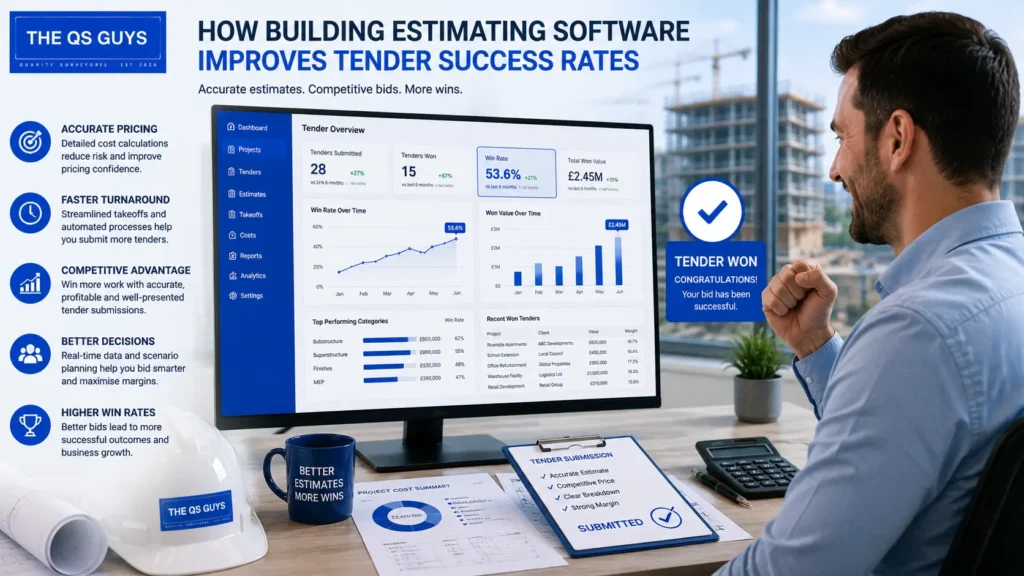
Winning construction tenders requires more than simply offering the lowest price. Contractors need to submit accurate, competitive, and well-prepared bids that reflect the true scope of work while protecting profitability. Building estimating software helps construction businesses achieve this balance by improving speed, accuracy, consistency, and financial visibility throughout the tendering process. Whether you are preparing bids for residential projects, commercial developments, or public sector contracts, the right estimating software can strengthen your tender submissions and improve your chances of securing profitable work.
Faster Bid Preparation
One of the biggest advantages of building estimating software is the ability to prepare bids much faster than traditional manual methods. Construction projects often involve tight deadlines, and businesses that can respond quickly to tender opportunities gain a significant advantage.
Estimating software automates many time-consuming tasks, including quantity calculations, labour estimates, material costing, and quote generation. Instead of spending hours manually compiling spreadsheets, estimators can generate detailed cost breakdowns within a fraction of the time.
Key benefits of faster bid preparation include:
- Increased Tender Capacity: Businesses can submit more bids without increasing administrative workload.
- Reduced Administrative Effort: Automated calculations reduce the need for repetitive manual data entry.
- Quicker Client Response: Faster turnaround times help contractors respond promptly to client requests.
- Improved Workflow Efficiency: Teams can spend more time reviewing estimates rather than creating them from scratch.
When tender opportunities arise unexpectedly, the ability to prepare accurate bids quickly can make the difference between winning and losing a project.
More Accurate Project Costing
Accurate pricing is essential for tender success. Underestimating costs can lead to reduced profits or financial losses, while overestimating may result in losing competitive opportunities.
Building estimating software improves accuracy by using detailed cost databases, automated calculations, and standardized pricing structures. These tools help ensure that every component of the project is accounted for, including labour, materials, subcontractor costs, equipment, and overhead expenses.
Benefits of improved project costing include:
- Reduced Human Error: Automated calculations minimise mistakes commonly found in manual spreadsheets.
- Comprehensive Cost Coverage: All project components can be included within the estimate.
- Better Budget Forecasting: Contractors gain a clearer understanding of project expenses before submitting bids.
- Improved Pricing Confidence: Accurate estimates support more competitive and realistic tender submissions.
Accurate project costing not only improves tender quality but also helps construction businesses maintain healthy profit margins after project completion.
Better Risk Assessment
Every construction project carries some level of risk. Material price fluctuations, labour shortages, site conditions, weather delays, and design changes can all affect project costs and timelines.
Building estimating software helps contractors identify and evaluate these risks before submitting a tender. By analysing cost data and reviewing project variables in greater detail, estimators can make more informed decisions about pricing and contingency allowances.
Several areas where estimating software supports risk assessment include:
- Cost Sensitivity Analysis: Evaluates how pricing changes may impact project profitability.
- Contingency Planning: Allows contractors to account for unforeseen project challenges.
- Historical Data Review: Uses past project information to improve future estimating accuracy.
- Scenario Modelling: Compares different pricing strategies and project outcomes.
Effective risk assessment creates stronger, more realistic bids and reduces the likelihood of unexpected financial pressures during project delivery.
Consistent Pricing Across Projects
Consistency is often overlooked but plays a major role in tender management. When different estimators use different methods or pricing assumptions, businesses can experience significant variations in bid quality and accuracy.
Building estimating software helps standardize estimating processes across the organisation. Cost libraries, templates, and predefined pricing structures ensure that all team members work from the same information and follow the same methodology.
Advantages of consistent pricing include:
- Standardized Estimating Practices: All estimates follow a uniform process.
- Improved Bid Reliability: Clients receive professional and consistent quotations.
- Reduced Internal Discrepancies: Fewer pricing variations between team members.
- Stronger Brand Reputation: Consistent tender submissions help build trust with clients and stakeholders.
Consistency also makes it easier to review estimates internally and maintain quality control across multiple projects.
Improved Profit Margin Visibility
Many contractors focus heavily on winning work but pay less attention to understanding the profitability of individual projects. Building estimating software provides greater visibility into profit margins before a tender is submitted.
Detailed reporting features allow estimators to analyse costs, markups, overheads, and projected profits. This information helps businesses identify opportunities to improve profitability while remaining competitive within the market.
Ways software improves profit margin visibility include:
- Detailed Cost Breakdowns: Provides a clear view of every project expense.
- Markup Analysis: Helps determine whether pricing supports business goals.
- Profit Forecasting: Estimates potential returns before work begins.
- Financial Decision Support: Enables more informed tendering strategies.
By understanding the financial implications of each bid, contractors can avoid pursuing projects that carry excessive risk or insufficient profit potential.
Building estimating software has become an essential tool for modern construction businesses seeking to improve tender performance. By enabling faster bid preparation, increasing cost accuracy, supporting risk assessment, creating pricing consistency, and improving profit margin visibility, these platforms help contractors submit stronger tenders and make better business decisions. As competition within the UK construction industry continues to grow, businesses that invest in accurate and efficient estimating processes are often better positioned to secure profitable projects and achieve sustainable long-term growth.
Common Mistakes To Avoid When Choosing Estimating Software
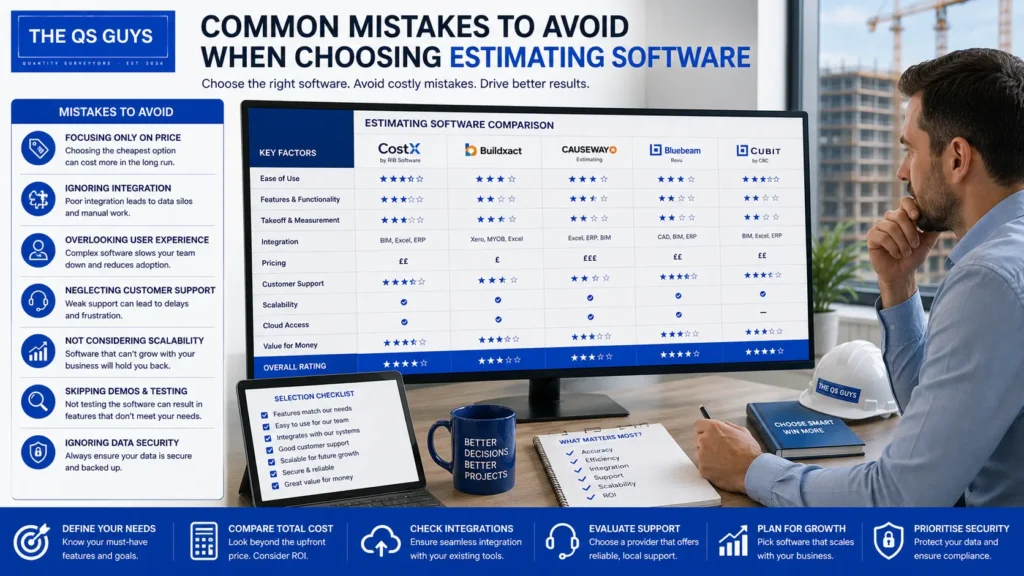
Selecting the right estimating software is a major decision for any construction business. The wrong choice can lead to inefficiencies, inaccurate cost estimates, poor adoption among team members, and unnecessary expenses. While many contractors focus on features and pricing, there are several common mistakes that can prevent a software investment from delivering its full value. Understanding these pitfalls can help builders, quantity surveyors, and construction companies choose a solution that supports both current operations and future goals.
Focusing Only on Price
Cost is an important factor when evaluating building estimating software, but it should never be the only consideration. Many businesses make the mistake of selecting the cheapest option available without fully assessing its capabilities, limitations, or long-term value.
A low-cost platform may appear attractive initially, but it can become expensive if it lacks the tools needed to improve estimating accuracy or streamline workflows. In some cases, companies end up purchasing additional software or investing significant time in manual processes to compensate for missing functionality.
When comparing software options, focus on the overall return on investment rather than the subscription fee alone.
- Feature Value: Consider whether the software includes digital takeoffs, tender management, reporting tools, and cost databases that can save time and improve accuracy.
- Time Savings: Faster estimate creation can allow your team to bid on more projects and increase revenue opportunities.
- Accuracy Benefits: Better cost forecasting helps reduce the risk of underpricing or budget overruns.
- Scalability: A slightly higher-priced solution may provide capabilities that support business growth for years to come.
The goal is to find software that delivers measurable business value rather than simply the lowest monthly cost.
Ignoring Integration Requirements
Construction businesses often rely on multiple software systems to manage estimating, accounting, project management, scheduling, and customer communication. Choosing estimating software without considering how it integrates with existing tools can create unnecessary inefficiencies.
When systems cannot communicate with one another, teams may be forced to enter the same information multiple times. This increases the likelihood of errors and consumes valuable administrative time.
Before making a decision, evaluate how the software fits within your current technology stack.
- Accounting Integration: Check whether the software connects with platforms such as Sage, Xero, or QuickBooks.
- Project Management Compatibility: Ensure project information can flow easily between estimating and project management systems.
- Data Consistency: Integrated systems reduce duplicate data entry and improve reporting accuracy.
- Workflow Efficiency: Connected software creates a smoother process from estimating through project delivery.
A well-integrated system can significantly improve operational efficiency and provide better visibility across the entire project lifecycle.
Choosing Software That Is Too Complex
More features do not always mean better software. Some estimating platforms are designed for large enterprises and may include advanced functionality that smaller businesses rarely use. Choosing software that is overly complex can lead to frustration, slower adoption, and reduced productivity.
If team members find the system difficult to learn or navigate, they may avoid using it altogether. This can undermine the benefits the software was intended to provide.
When evaluating solutions, focus on usability as much as functionality.
- User-Friendly Interface: The software should be intuitive and easy to navigate.
- Relevant Features: Prioritize tools that directly support your estimating process rather than unnecessary extras.
- Learning Curve: Consider how long it will take staff to become comfortable using the platform.
- Team Adoption: Simple systems are often adopted more quickly and consistently across the business.
The best building estimating software is not necessarily the one with the most features. It is the one your team can use effectively every day.
Overlooking Training and Support
Even the most powerful estimating software requires proper implementation and ongoing support. Many companies underestimate the importance of training resources and customer assistance when selecting a provider.
Without adequate onboarding, users may fail to take advantage of key features or develop inefficient workarounds. Poor support can also lead to extended downtime when technical issues arise.
Evaluate the vendor’s support offerings before committing to a platform.
- Training Resources: Look for tutorials, webinars, documentation, and onboarding programs.
- Customer Support Availability: Check support hours and response times.
- Knowledge Base Access: A comprehensive help centre can help users resolve common issues independently.
- Ongoing Updates: Regular improvements demonstrate a provider’s commitment to product development.
Strong support can significantly improve the overall software experience and help your team achieve faster results.
Not Considering Future Business Growth
Many construction businesses choose software based solely on their current needs. While this may seem practical, it can create problems as the company expands, takes on larger projects, or hires additional staff.
Software that works well for a small team today may become restrictive as project complexity increases. Replacing systems later can be costly and disruptive.
Consider where your business may be in three to five years and select software that can grow alongside it.
- User Expansion: Ensure the platform can accommodate additional team members.
- Project Capacity: Verify that the software can manage larger and more complex projects.
- Advanced Features: Consider whether future requirements may include detailed reporting, forecasting, or multi-location management.
- Long-Term Flexibility: Scalable software reduces the need for costly migrations later.
Planning for future growth helps ensure your investment remains valuable as your business evolves and new opportunities arise.
Choosing building estimating software is about more than comparing prices or feature lists. The most successful decisions come from understanding how a solution fits your workflows, integrates with existing systems, supports your team, and aligns with your long-term business objectives. By avoiding these common mistakes, construction professionals can select software that improves estimating accuracy, increases efficiency, and delivers lasting value.
How To Choose The Right Building Estimating Software For Your Business
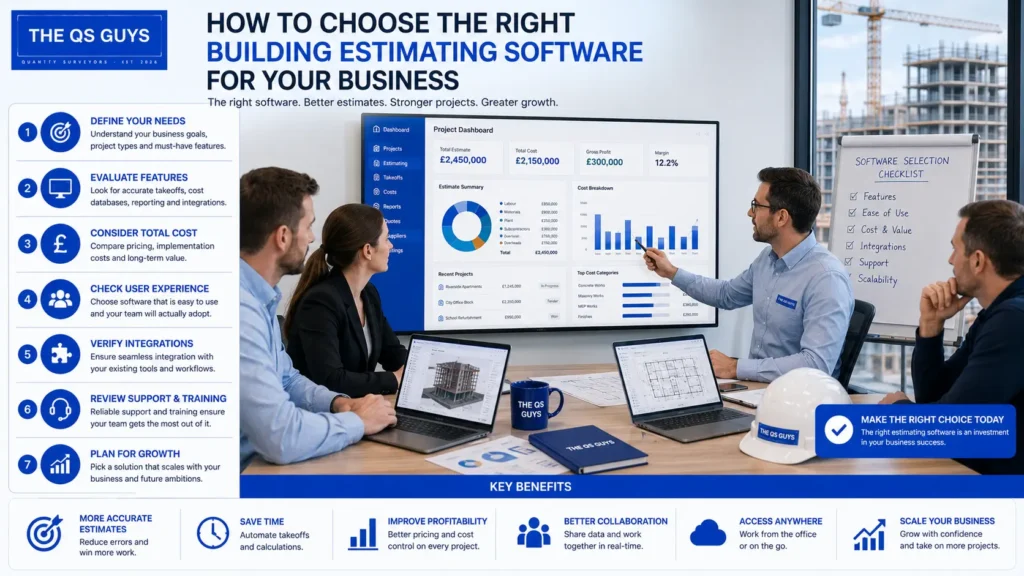
Selecting the right building estimating software can have a significant impact on the efficiency, accuracy, and profitability of your construction business. With many solutions available, it is important to look beyond marketing claims and focus on how a platform fits your day-to-day operations. The best building estimating software should help your team create accurate estimates faster, improve project planning, and support business growth without adding unnecessary complexity. Taking the time to evaluate your needs carefully will help you invest in a solution that delivers long-term value.
Assess Your Current Estimating Process
Before comparing software options, it is important to understand how your existing estimating process works. Identifying strengths and weaknesses in your current workflow will help you determine which features are most valuable for your business.
Many construction companies still rely on spreadsheets, manual calculations, or disconnected systems. While these methods may work for smaller projects, they often become time-consuming and increase the risk of errors as project complexity grows.
When reviewing your current process, consider:
- Accuracy Issues: Are estimating mistakes leading to budget overruns, missed costs, or reduced profit margins?
- Time Requirements: How long does it take to complete an estimate from start to finish?
- Data Management: Is project information stored in multiple locations, making it difficult to access and update?
- Collaboration Challenges: Can team members easily share and review estimates?
- Reporting Needs: Do you have visibility into estimate performance and project costs?
Understanding these factors provides a clear starting point for selecting software that addresses specific operational challenges rather than simply adding new technology.
Define Your Budget and Requirements
Building estimating software varies significantly in both pricing and functionality. Some platforms are designed for small contractors, while others offer advanced capabilities for larger construction firms and quantity surveyors.
Rather than focusing solely on cost, consider the overall value the software can provide. A slightly higher investment may save hundreds of hours each year through improved efficiency and reduced estimating errors.
Key requirements to evaluate include:
- Digital Takeoffs: Ability to measure quantities directly from plans and drawings.
- Cost Databases: Access to labour, material, and supplier pricing information.
- Tender Management: Tools for preparing and submitting competitive bids.
- Cloud Access: Secure access to estimates from multiple locations.
- Integration Options: Compatibility with accounting and project management software.
- Reporting Features: Visibility into costs, profitability, and project performance.
Creating a list of essential and optional features can make software comparisons more objective and prevent unnecessary spending on tools that may never be used.
Consider Team Size and Project Volume
The size of your team and the number of projects you manage should influence your software decision. A solution that works well for a sole contractor may not provide the functionality needed for a larger construction company managing multiple projects simultaneously.
For smaller businesses, simplicity and ease of use are often priorities. A straightforward platform can reduce training requirements and help users become productive quickly.
Larger organisations may require more advanced capabilities, such as:
- Multi-User Access: Allowing multiple estimators and project managers to work within the system.
- Permission Controls: Managing user roles and data access.
- Project Tracking: Monitoring multiple estimates and projects simultaneously.
- Custom Reporting: Generating detailed business and project insights.
- Workflow Automation: Reducing repetitive administrative tasks.
Choosing software that aligns with both your current needs and future growth plans can prevent costly migrations later.
Request Demonstrations and Free Trials
One of the most effective ways to evaluate construction estimating software is to test it before making a commitment. Product demonstrations and free trials allow you to see how the platform performs in real-world scenarios and determine whether it fits your workflow.
A software provider’s website can highlight features, but hands-on experience often reveals usability strengths and weaknesses that are difficult to identify from marketing materials alone.
During a demonstration or trial period, pay attention to:
- Ease of Use: How quickly can users learn the system?
- Estimate Creation Speed: Does the software simplify the estimating process?
- Interface Design: Is navigation clear and intuitive?
- Feature Relevance: Are the available tools genuinely useful for your projects?
- Performance Reliability: Does the platform operate smoothly without technical issues?
Testing the software with a real project estimate can provide valuable insight into how it will perform once implemented across your business.
Evaluate Customer Support and Ongoing Updates
Software is not a one-time purchase. Ongoing support, product development, and regular updates play a major role in long-term success. Even the most powerful estimating platform can become frustrating if support is difficult to access when problems arise.
Strong customer support can reduce downtime, improve user adoption, and help your team get the most value from the software.
When evaluating providers, consider:
- Training Resources: Availability of tutorials, guides, and onboarding assistance.
- Technical Support: Access to knowledgeable support teams when issues occur.
- Software Updates: Frequency of feature improvements and security updates.
- Customer Reviews: Feedback from other construction professionals.
- Industry Expertise: Experience serving construction businesses and understanding industry-specific needs.
A provider that actively invests in product development and customer success is more likely to deliver a reliable solution that continues to meet your needs as your business evolves.
Choosing the right building estimating software is about more than comparing feature lists. By assessing your current process, defining clear requirements, considering your team’s needs, testing software through demonstrations, and evaluating long-term support, you can make a well-informed decision that improves estimating accuracy, saves time, and supports sustainable business growth.
Choosing the right building estimating software can have a lasting impact on your business, from improving estimating accuracy to increasing tender success and protecting profit margins. Explore our expert comparisons and recommendations to find the solution that best fits your projects, team size, and budget. By making an informed decision today, you can simplify your estimating process, reduce costly mistakes, and position your construction business for sustainable growth and long-term success.
References
- RIB CostX Best 2D, Estimating & BIM Takeoff Software
https://www.rib-software.com/en/rib-costx - Construction Estimating Software | Buildxact UK
https://www.buildxact.com/uk/features/construction-estimating-software/ - Estimating Software for Construction Companies | Causeway
https://www.causeway.com/commercial/estimating - Best Construction Estimating Software 2026 | Access ConQuest
https://www.theaccessgroup.com/en-gb/construction/software/estimating/best-construction-estimating-software/ - 5 Best Construction Estimation Software for UK Contractors
https://buildpartner.com/5-best-construction-estimation-software-for-uk-contractors/
FAQs: About Best Building Estimating Software In UK
What is the best building estimating software UK construction companies can use?
The best building estimating software UK businesses can use depends on their size, project type, and budget. Popular options include CostX, Buildxact, Causeway Estimating, ConQuest Estimating, Bluebeam Revu, and Cubit. These solutions offer features such as digital takeoffs, cost databases, tender management, and project budgeting tools.
How does building estimating software improve project accuracy?
Building estimating software reduces manual calculations and automates many aspects of cost planning. It helps contractors accurately estimate materials, labour, equipment, and overheads, reducing the risk of costly mistakes and budget overruns.
Is building estimating software suitable for small builders?
Yes, many estimating software platforms are designed specifically for small and medium-sized construction businesses. These solutions help smaller firms create professional estimates, save time on quoting, and compete more effectively for projects without requiring large administrative teams.
What features should I look for in construction estimating software?
Key features include digital takeoff tools, labour and material costing, tender management, reporting capabilities, cloud access, and integration with accounting software. The best solution should match your business workflow and support future growth.
How much does building estimating software cost in the UK?
Pricing varies depending on the software provider, number of users, and available features. Some entry-level platforms charge monthly subscriptions, while enterprise-level solutions may require custom pricing based on company size and project requirements.
Can building estimating software integrate with accounting systems?
Many modern estimating platforms integrate with accounting software such as Sage, Xero, and QuickBooks. This helps streamline financial management, reduce duplicate data entry, and improve visibility across estimating and accounting processes.
What is the difference between estimating software and takeoff software?
Takeoff software focuses on measuring quantities from plans and drawings, while estimating software converts those quantities into project costs. Many construction platforms combine both functions to provide a complete estimating and budgeting solution.
Does estimating software help win more construction tenders?
Yes, estimating software can improve tender success by helping contractors create accurate, professional, and competitive bids more efficiently. Faster turnaround times and more reliable pricing often improve a company’s ability to secure new projects.
Is cloud-based building estimating software better than desktop software?
Cloud-based software offers advantages such as remote access, real-time collaboration, automatic updates, and easier data sharing between team members. Desktop software may still suit some businesses, but many firms now prefer cloud-based solutions for greater flexibility.
How do I choose the right building estimating software for my business?
Start by assessing your project volume, budget, team size, and current estimating process. Compare software features, request demonstrations, test free trials, and evaluate customer support before making a decision. The right platform should improve efficiency while supporting your long-term business goals.
Conclusion
Selecting the best building estimating software UK construction professionals can rely on requires more than simply comparing prices or feature lists. The right solution should support your business size, project type, estimating process, and long-term growth objectives. Key factors to consider include estimating accuracy, digital takeoff capabilities, integration with accounting and project management systems, ease of use, customer support, and scalability. Accurate estimating plays a critical role in protecting profit margins, reducing costly errors, improving budget control, and increasing the likelihood of winning competitive tenders. Whether you operate as a small builder, a growing contractor, or a large construction company, investing in software that aligns with your daily workflow can save significant time and improve decision-making across every stage of a project. Taking the time to compare available options, explore demonstrations, and evaluate how each platform fits your operational requirements will help ensure you choose a solution that delivers lasting value and supports sustainable business growth.